Tag Archives: Carbon in the ocean

Watts Up? – The Quadra Report

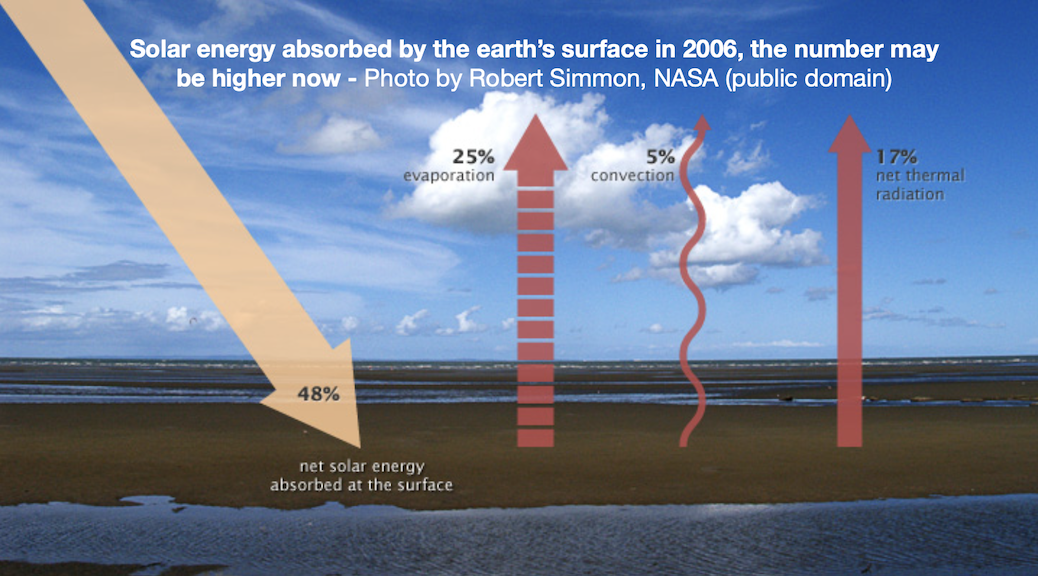
Besides calculating global warming by correlating it to the carbon dioxide concentration in the atmosphere—which, incidentally has now risen from 280 ppm to nearly 430 ppm—another method is to measure the direct heating of Earth’s surface that comes from sunshine. This is done by measuring the energy that strikes the surface of our planet as watts per square metre. This energy is then reflected from Earth’s surface as radiant heat, blocked from escaping back into space primarily by the carbon dioxide in the atmosphere.

Without the warming effect of any greenhouse atmospheric gases, the energy we get directly from the sun would only heat Earth to -18°C. In other words, the unique gaseous composition of the atmosphere enveloping our planet warms it to the so-called “Goldilocks Zone”—not too hot and not too cold for sustaining life as we understand it.

Unfortunately, writes Madeleine Cuff in New Scientist (“Earth Warms as Heat Trapping Doubles”, June 15, 2024). “Earth’s atmosphere is trapping more than twice as much excess heat as it did in 1993.” The surplus heat “in the climate system… is the difference between how much energy enters Earth’s atmosphere from the sun, and how much is radiated back into space.”

Continue reading Watts Up? – The Quadra Report

UN manifesto pitches preservation of critical microscopic creatures

Canada’s National Observer, Local Journalism Initiative Reporter

Plankton, the key ingredient of the primordial ocean soup that allows all life to flourish, are central to a new U.N. manifesto highlighting the big role microscopic creatures can play in tackling the globe’s triple threat. 

Plankton are largely ignored in international discussions around preserving the planet from the climate crisis, biodiversity collapse and pollution, said Vincent Doumeizel, senior advisor on the oceans to the United Nations (U.N.) Global Compact.

Continue reading UN manifesto pitches preservation of critical microscopic creatures

The Quadra Project – Deep Water

By Ray Grigg

When we think about environmentalism, we tend not to consider the oceans because we don’t live on or in them, and they are just there as they have always been, defining the edge of the land that we occupy. Of course, oceans provide us with most of our fish, but in the popular understanding, they are mostly experienced as vast spaces of waves and wet that separate the faraway continents that we visit. So we tend to give much more importance to landscapes that we occupy. And because we live within the thin layer of air that girdles the globe, weather is also a concern to us. But we generally don’t consider that much of our climate and weather is determined by what happens in the oceans.

Continue reading The Quadra Project – Deep Water

B.C. launches blueprint to fend off climate’s ‘one-two punch’ on the ocean

Canada’s National Observer, Local Journalism Initiative Reporter

B.C. has unveiled an action plan to tackle the two greatest climate threats to the ocean, coastal communities and marine ecosystems on the West Coast. 

Ocean acidification and hypoxia (OAH), or plummeting oxygen levels, that often occur in tandem with a snowball effect, are spiking due to human-caused greenhouse gas emissions. 

The plan’s goals include strengthening scientific collaboration and research and public awareness on these issues. Finding ways to adapt to or mitigate the negative impacts of OAH is also a priority. 

The province also wants a better understanding of how or if blue carbon — CO2 captured naturally from the atmosphere by marine plants and algae — could or should be used as a natural solution to buffer acidification and hypoxia.  

Continue reading B.C. launches blueprint to fend off climate’s ‘one-two punch’ on the ocean

Unchecked climate change puts Canada’s West Coast in hot water

Canada’s National Observer, Local Journalism Initiative Reporter

Last year was the hottest on record for the ocean, an upward trend only expected to continue as it wreaks havoc on coastal communities and spurs irreversible losses to marine ecosystems. 

Ocean warming has cascading effects, melting polar ice and causing sea-level rise, marine heat waves and ocean acidification, the United Nations’ panel of climate experts made clear on Monday.

Sea-level rise has doubled in the last three decades, reaching a record high in 2021, the Intergovernmental Panel on Climate Change reported. Rising seas, coupled with more extreme weather, are setting the stage for a perfect storm of flooding for coastal communities. 

Continue reading Unchecked climate change puts Canada’s West Coast in hot water