

Category Archives: Technology

Why Cortes Island does not need Facebook

While there are Facebook groups on Cortes Island, they have largely been  marginalized by a wiki style community bulletin board. The Tideline is not a place for personal webpages or a typical news website, but for the past 20 years most of island’s population have used it to post notices, community announcements, reports and advertisements.

Someone suggested that this may be a model for the rest of the country to emulate, now that Facebook has barred Canadian news outlets from using its pages. 

This prompted me to ask a few people at Lovefest for their opinion. 

Continue reading Why Cortes Island does not need Facebook
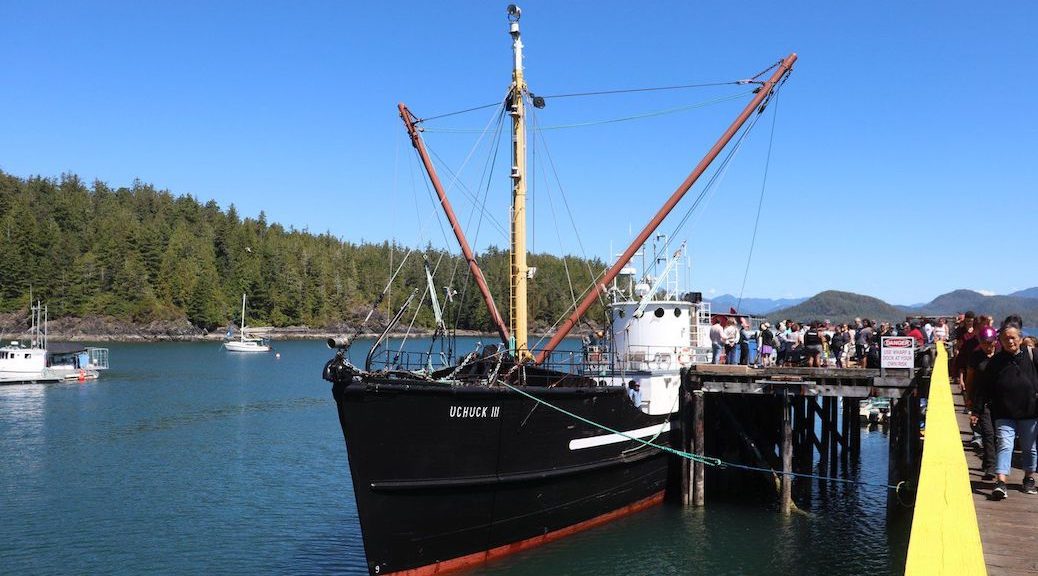
Decades of service in Nuu-chah-nulth waters for what could be ‘the last wooden freighter on the coast’

Editor’s note: The Uchuck III is the last in a series of steamships that began with the Uchuck, built in Vancouver during 1928 for the Packers Steamship Co. The Uchuck I, was built in Coal Harbour, Vancouver, during 1941 to replace the Uchuck and by 1946 was making three scheduled trips a week from Port Alberni to Bamfield, the south shore of Barkley Sound and Ucluelet before , and returning home. A second vessel, the Uchuck II was added in 1948 to handle the increased traffic. A third vessel, the Uchuck III, was purchased for the fleet in 19521.

By Alexandra Mehl, Ha-Shilth-Sa, Local Journalism Initiative Reporter

Yuquot, BC – The Uchuck III is a beloved cargo and passenger vessel that has been serving Nootka Sound for decades bringing the Mowachaht/Muchalaht nation back to their ancestral home, Yuquot, while delivering supplies to remote First Nations and industry camps.

Each summer, on Wednesdays and Saturdays, the Uchuck III departs from the Gold River dock, travelling through the Muchalat Inlet to Nootka Sound, past Bligh Island, and arrives two hours later at Friendly Cove, also known as Yuquot.

Continue reading Decades of service in Nuu-chah-nulth waters for what could be ‘the last wooden freighter on the coast’

Delores Broten: The problem with Facebook

Google and Facebook took in $9.7 billion in advertising revenue during 2020, while the revenues of more traditional news outlets – who produce much of the actual news being posted on Facebook and Instagram – are failing. In response to Bill C-18, which requires them to pay Canadian media outlets a fraction of their advertisement revenues, the dynamic duo will no longer let Canadian news outlets post. 

This was brought home to Cortes Currents on Wednesday, August 2, when Facebook served notice that as a news outlet, Cortes Currents Facebook posts will no longer be viewable inside Canada. 

As only about 10% of my web traffic actually comes through Facebook, my reactions were mixed, but the strongest was curiosity. 

So I reached out to some local media outlets to find out:

  1. What is their opinion of the situation?
  2. How does being cut off from Facebook affect their publication? 

The first to respond was a well known former Cortes resident, Delores Broten of the Watershed Sentinel.  

Continue reading Delores Broten: The problem with Facebook

Canada makes good on promise to end fossil fuel subsidies, with exceptions

Editor’s note: a decision that will affect all of us.

By Natasha Bulowski, Canada’s National Observer, Local Journalism Initiative Reporter

Canada now has a set of guidelines to restrict federal subsidies to the fossil fuel sector, albeit with numerous exceptions.

The long-awaited announcement delivers on the federal government’s promise to end inefficient subsidies to the fossil fuel sector by the end of 2023. In Environment and Climate Change Minister Steven Guilbeault’s words, the framework ensures funding and tax measures from federal departments only go “to projects that decarbonize the sector and result in significant greenhouse gas emission reduction.” He announced the framework Monday morning in Montreal

The new rules — if applied “with integrity” — should prevent the creation of new handouts of public money to fossil fuel companies most responsible for the climate crisis, said Julia Levin, associate director of national climate for Environmental Defence.

Continue reading Canada makes good on promise to end fossil fuel subsidies, with exceptions

Trans Mountain wants higher tolls, and they won’t cover even half its price tag

By Natasha Bulowski, Canada’s National Observer, Local Journalism Initiative Reporter

Trans Mountain wants to charge oil shippers more to use the Trans Mountain expansion pipeline (TMX), but those increased tolls wouldn’t cover even half of the project’s $30.9-billion price tag.

“There has never been an instance in any western country — that I’m aware of — where tolls have been set below the level required to cover the cost of the operation of a pipeline,” said Thomas Gunton, professor and director of the Resource and Environmental Planning Program at Simon Fraser University in B.C.

Continue reading Trans Mountain wants higher tolls, and they won’t cover even half its price tag