


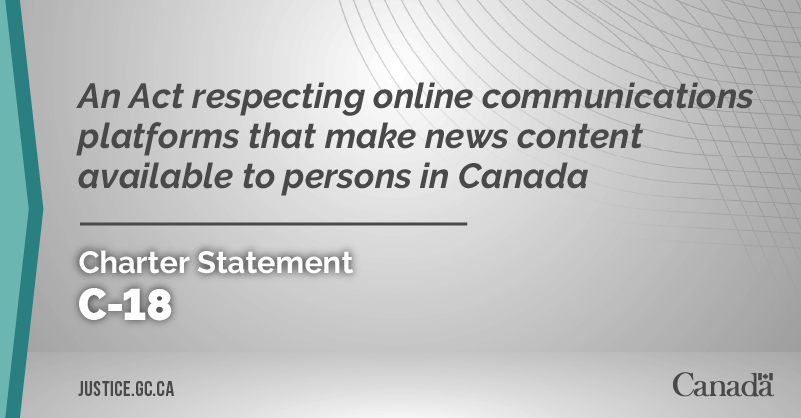
Google and Facebook took in $9.7 billion in advertising revenue during 2020, while the revenues of more traditional news outlets – who produce much of the actual news being posted on Facebook and Instagram – are failing. In response to Bill C-18, which requires them to pay Canadian media outlets a fraction of their advertisement revenues, the dynamic duo will no longer let Canadian news outlets post.
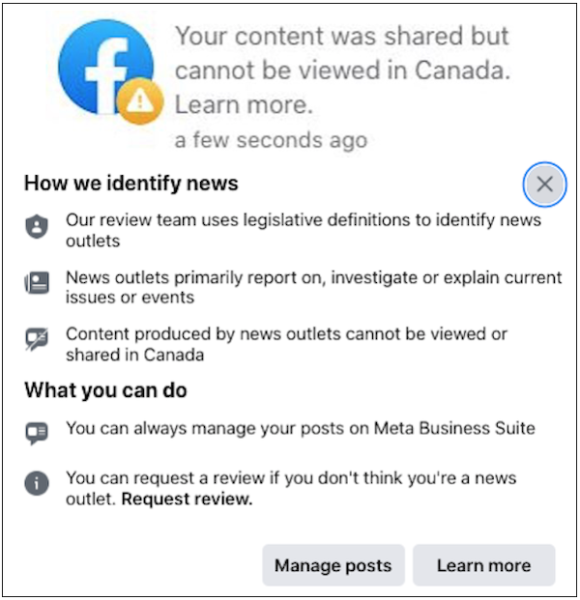
This was brought home to Cortes Currents on Wednesday, August 2, when Facebook served notice that as a news outlet, Cortes Currents Facebook posts will no longer be viewable inside Canada.
As only about 10% of my web traffic actually comes through Facebook, my reactions were mixed, but the strongest was curiosity.
So I reached out to some local media outlets to find out:
- What is their opinion of the situation?
- How does being cut off from Facebook affect their publication?
The first to respond was a well known former Cortes resident, Delores Broten of the Watershed Sentinel.
“It’s essentially a line in the sand for Canadian identity, in my mind. I’m into that stuff these days because my mother’s family’s Ukrainian. We’re focusing on identity destruction these days, but this is part of that Americanization of Canada that’s been going on since the fifties. There were various political movements and attempts to resist it even before that. In about the 1880s, there was a movement saying ‘Canada first.’ It’s always been a constant pressure. You have a big rich neighbor and a little colonial racist country, and we’ve had some good points, but overall, we have very little to keep this country separate. So with the news media going down, all the news is just going to be Hollywood gossip and Trump, Trump, Trump, Trump,” she said.
CC: Why Should Facebook give Canadian media a portion of its revenues?
DB: “Why should radio stations pay the artists for their songs? When a radio station plays a song, they’re using the artist and the producer and the whole company’s work. They pay a royalty for that. ”
Speaking as a former President of the Cortes Community Radio Society, this statement elicits mixed responses. Most of the artists I (Roy Hales) know are receiving what amounts to the price of a cup of coffee per year, but volunteer run stations like CKTZ cannot afford to pay higher SOCAN fees. (I do not know what for profit radio stations are paying.) That said, I agree with the principle that she cites, artists should be paid for their work.
DB: “This is the same thing when Facebook and Instagram use News content that people like me and you and (God love us) Postmedia sometimes pay writers to create. They’re using our work for free. In the meantime, while they’re doing that and building their audience, they are taking 10 billion, with a B, 10 billion a year in advertising revenue out of Canada and not paying a single cent of tax.”
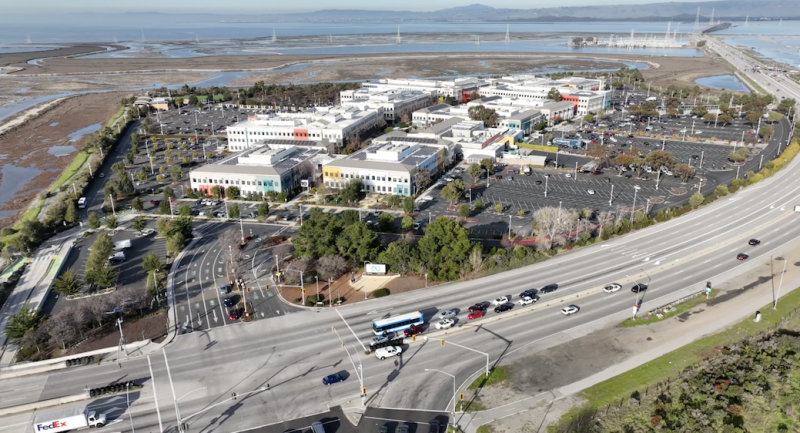
According to the Columbia Journalism Review, Google and Facebook are paying the media in Australia close to $150 million US a year. This has enabled the Australian Broadcasting Corporation to place 50 new journalists in underserved parts of the country. The United Kingdom, Indonesia and South Africa are considering similar legislation, as is the state of California.
CC: What was the remedy that the Canadian government came up with?
DB: “The government was asking them to put about $250 million towards compensating news organizations.”
CC: Do we have any idea how that would be administered?
DB: “I don’t, I haven’t read the act. Actually, they probably haven’t written that part yet. I don’t think it matters. I think there are a couple of things that matter. One is that megacorporations are trying to tell the Canadian government what to do. It’s not Facebook’s role to tell our government what to do. So that’s one huge thing about Canadian identity survival, living up against that elephant in the room on the continent, which is the pure, unending struggle of Canadian identity to survive next to the American megaphone.”
“The other issue is why would someone not pay if you’re using their work? It’s that simple, and the fact that Mark Zuckerberg doesn’t like it is not my problem.”
“I don’t even know what more needs to be said to tell the truth because that sums it up for me. I don’t think it’s going to affect the Watershed Sentinel because (A) we’re too small, and (B) they were labeled as a book and magazine publisher, instead of a news organization. So we might escape, but I don’t care.”
CC: You mean you haven’t been prohibited?
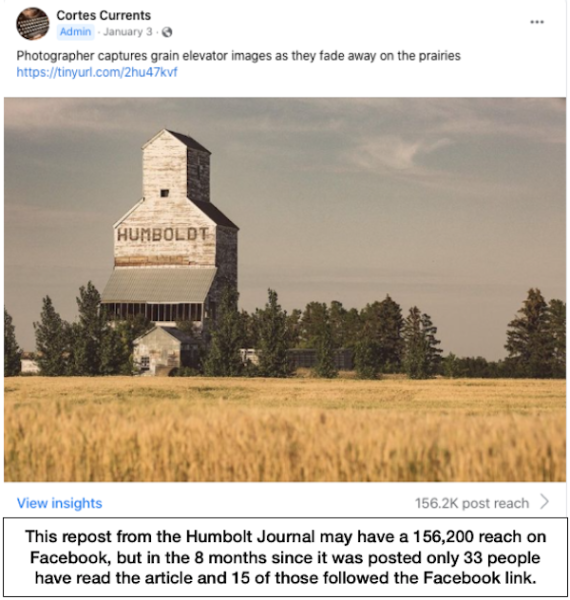
DB: “Not that I’ve noticed. I hardly ever go on Facebook to tell the truth. I got bored with it. It’s important to our writers because they need to get noticed. It delivers a little bit for our web traffic, but most people just look at the Facebook posts.”
(We did a test and found that, at the time of our interview, the Watershed Sentinel could still post on Facebook.)
“The other issue is the context in which this is happening, it’s basically a slaughter room out there in terms of jobs for journalists. Print media is fading away like a dodo and I think that’s really too bad because we actually have legal responsibility for what we print, which I don’t think anyone else does, or at least it isn’t enforced. There’s a certain standard of liability and verifiability etc that print is held to. When we make a mistake, we make it in thousands of copies that don’t go anywhere.”
CC: And you can’t fix it up online.
DB: “Exactly, so you have to be really careful. I’ve never been sued for libel yet. A couple of times people have tried, or wanted to, but it didn’t happen/couldn’t happen because we are really careful.”
“But that liability, that solidity that accompanies that print obligation, the libel laws and all the rest of it, I think that’s something our society could use a bit more of.”
“I’m not exactly going to go to bat for Postmedia, which is another mega American corporation and they own an awful lot of what’s left of the print newspapers in the country. They even bought the Toronto Star, which is really disturbing.”
“Nonetheless, how the media is going to make a living in this atmosphere is hard to see. We can survive on donations and this and that and so could everyone else, but that just means the people who support our viewpoint support us. The people who support some other viewpoint, like the oil industry, support someone else, probably with a little deeper pockets. It just fragments, fragments and fragments the social view.”
“If there’s no consensus on what happened, when, or what’s true, where are we? We’re just running around hating each other and I find it really gross.”
CC: When we have sources that aren’t being factual and we know they’re not being factual and you can’t afford to take them to court, what can we do about it?
DB: “It’s a huge problem and I don’t even know how many precedents there are because I think the social media folks say that ‘it’s just commentary.’ They’re not responsible for what they post because it’s only commentary, we’ve got ‘free speech’ and all that.”
CC: Is there anything more you would like to add about the situation with Facebook?
DB: “I can’t say anything polite.”
CC: I don’t care if you’re polite, if you can live with it.
DB: “Well, Facebook should go pound sand.”
“If we let another corporation tell our government what to do, we might as well just quit. It’s bad enough with oil and gas. This is just like saying, come get us. We don’t exist. I don’t know if our government can stick to it or not. Maybe, maybe they’ll just pour more money into Postmedia.”
CC: I’m suspecting that if they do get some more money, it’ll go into something like the LJI (Local Journalism Initiative) program again.
DB: “Yes, that produced an awful lot of interesting copy. Once upon a time that’s what little local newspapers wanted to be: journalists, not just good old boys.”
Disclosure: For the past two years, Cortes Currents has been posting a weekly list of articles found under the Cortes tab, on Tideline. I was also posting links on two Facebook pages, Cortes Radio and Cortes Currents, prior to being barred as a Canadian news outlet. About 10% of my monthly traffic came through social media.
Top image credit: Facebook backlash – Photo by Book Catalog on Flickr (CC BY SA, 2.0 License)
Sign-up for Cortes Currents email-out:
To receive an emailed catalogue of articles on Cortes Currents, send a (blank) email to subscribe to your desired frequency:
- Daily, (articles posted during the last 24 hours) – [email protected]
- Weekly Digest cortescurrents – [email protected]