

The first time many Cortes Island residents heard of Doug McCaffry was when he and his wife, Melanie, took over Becca’s beans. Prior to that they were living in central Saanich.
“We came for a vacation. It was a beautiful August, and I’d always wanted to come to Cortes. I thought, ‘hey, just for fun, let’s look at some real estate.’ The place we’re at now had just come up for sale and came with the optional coffee roastery. I thought, ‘well, I love coffee, let’s learn coffee roasting.’ It all happened so fast. Two of the things I love most in life, coffee and film, and I’m in heaven,” he explained.
Old movie projector – Photo by emma.kate via Flickr (CC BY-ND 2.0 DEED)
“So many things have been captured on film over the past 120 years. There’s millions of cans of film around the world. If these films aren’t looked after, they’re just going to disappear. I think it’s very important that we archive, catalog and keep this window from the past with us. Digitizing and restoring, that’s probably the bulk of what I do. Each project seems to be a little bit different. I work with archives and I’m learning more and more about it.”
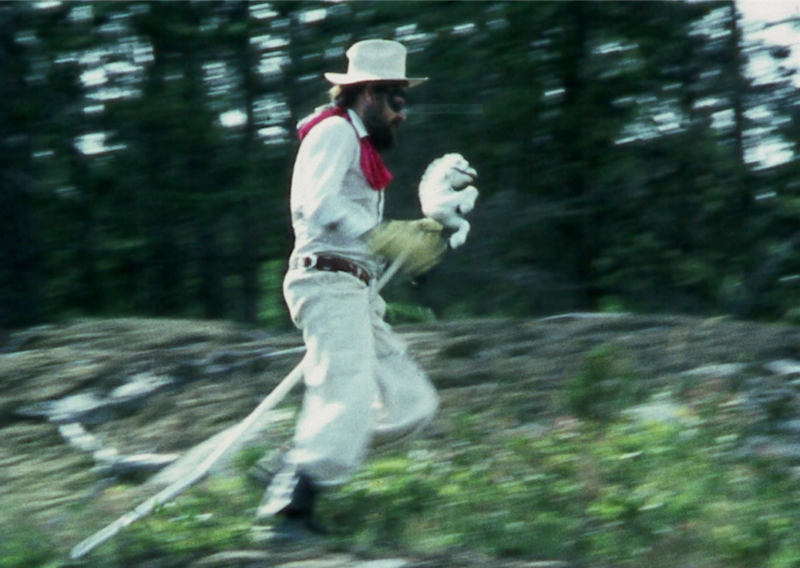
The 2022 film festival at Mansons Hall was his idea.
“That was an interesting project, working with George Sirk, and having the Cortes Cinema film night. It seemed to be quite a success, and everybody enjoyed themselves. A lot of people regret missing it. I think we’re going to have an encore. This March, maybe, we’re going to team up with the Museum and Archives and do another film night of vintage Cortes Cinema.”
CC: How did you get into this business?
Doug McCaffry: “I got into graphic arts shortly after I finished school. At that time there was a real labour shortage for skilled people, so I could pretty much pick and choose where I wanted to work. I loved travelling back in those days, and so I could basically do working holidays almost wherever I went. I lived in New Zealand, Britain, Southeast Asia Britain, and all around Europe.”
“I would take the images, put them on a large plexiglass drum, and they’d spin at about 600 RPM, (go through) a fibre optic light and the images would come out the other end digitized. Then we could build whatever it is, a newspaper, a book, a magazine, a catalog, that sort of thing.”
“It seemed like a natural progression moving on to motion picture film. I’ve always loved movies, especially foreign films and I started collecting Italian films on 16 mm. I’d find them on eBay and I ended up with a collection. I thought, ‘hey, well, I’m in the graphic arts, restoring images, working on images and artwork. It can’t be that much different from restoring motion picture film.’ So I looked into it. I took some courses. I got a lot of help from a company in Austria who’s developed some amazing film restoration software and started doing that.”
“I thought, ‘Why don’t I look into buying a motion picture film scanner?’ So I bit the bullet and basically took out another mortgage to get some of this equipment.”
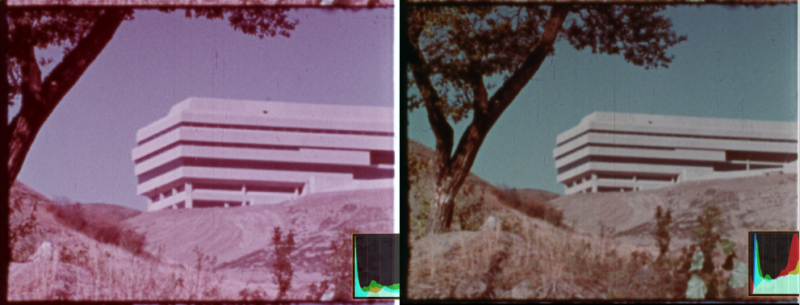
“Luckily enough, I did get a contract with a large university film archive. The project lasted about two years.They gave me about 450 mostly large reels of film. I did a rough calculation. There are probably over nine and a half million frames that I scanned during that period. Everything from documentaries to student films to Architects that ended up being documented by the CBC. Some of the student films were really interesting. A lot of avant-garde experimental film. The one that really sticks out looked like it was supposed to be a comedy horror with lots of nudity. This is probably going back to the 60s or 70s. So it would have been unusual for that time. I thought that was quite funny. I don’t think it was a completed film. Whoever was making it probably dropped out of school.”
“Film can come from anywhere. We source a lot of film from private collections, from university archives, from cinematics, collectors.”
“I worked on some film from New Zealand that was shot back in the 20s and 30s. If film is stored correctly, it can last quite a long, long time. A lot of this film looked like it was shot last year, but it was obviously from another time period. Somebody looked after these films and that project worked out really well. I think everybody was happy.”
“The amazing thing is when you finally get to see the finished product, it’s like, ‘Wow, that’s what was on these reels in my basement all these years!'”
Cortes Currents: A lot of people used to have home movie cameras, what happened?
Doug McCaffry: “Back in the mid to late 80s companies like Fuji and even Kodak started coming out with the digital cameras, the little cassette, little mini VHSs, I think they were called Hi8. From there it just evolved into digital cameras like the phone you’ve got in your pocket, I imagine. No moving parts. You can just plug into your laptop and you’ve pretty much bypassed the film stage. Everything’s just electronic signals.”
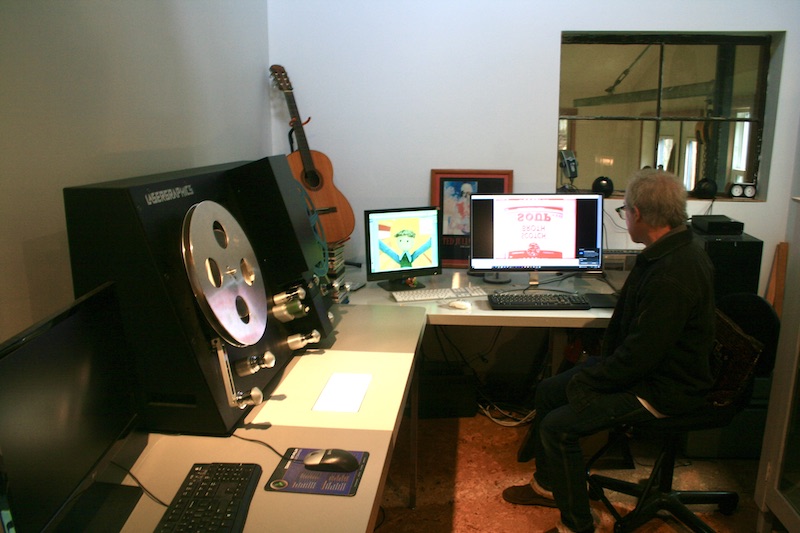
– Roy L Hales photo
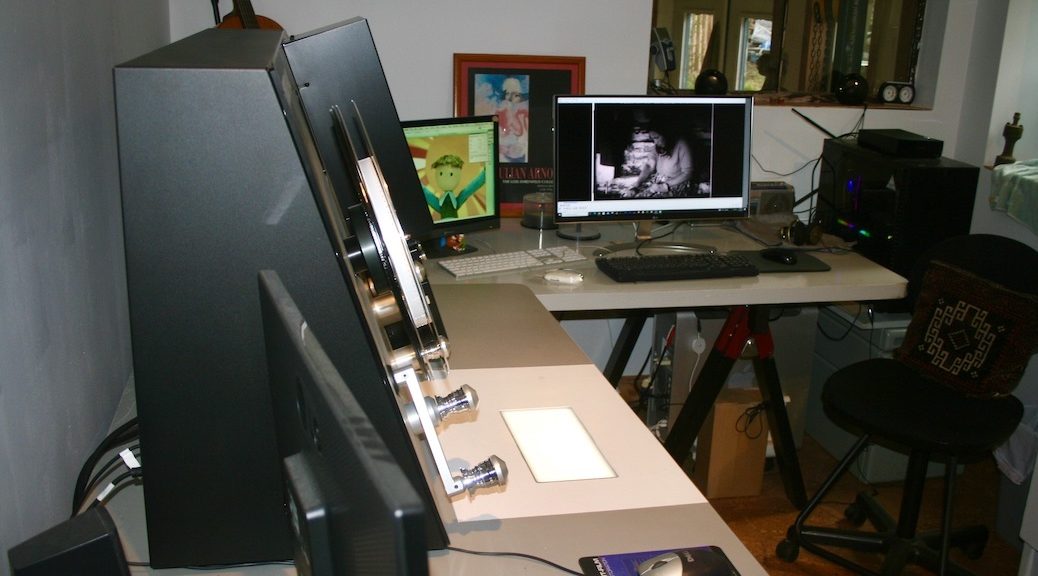
Doug gave me a tour of his studio.
“We’ve got, I call it my supercomputer. It can handle a lot of information at one time. One frame of film could be up to 70 megabytes. If you’ve got a film with about 300, 000 frames, that’s scanning in real time, 24 frames a second, it’s pushing a lot of information.”
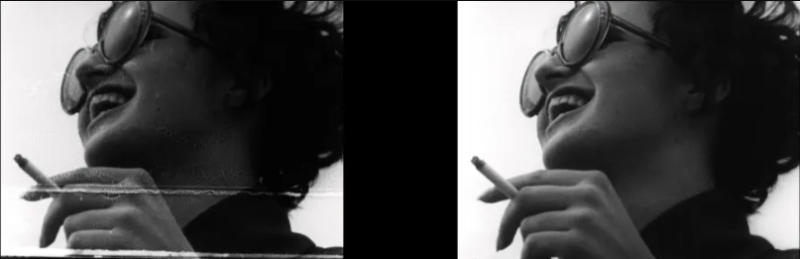
“It gets that information from the film scanner, which is this device over here. It’s made by Lasergraphics in Los Angeles. They’re used all over the world. A lot of the major DVD and Blu-ray labels that restore film and put them out on disc, use this exact equipment to digitize those films.”
“Quite often they use the original negatives. That’s probably the best thing, to be working from the negative, but film positive is fine as well. Take our local filmmaker George Sirk, for example, they were all 16 mm, 8 mm film positives from the 70s and 80s.”
“We put the film on the film scanner. You can do colour correction, you can figure out the frame rate of the film. Quite often I do overscan, so that includes a little bit of the sprockets on the side, just so the customer knows he or she has the whole image, and then you can crop from there down to size. This scanner does anywhere from 8 to Super 8, 16 and 35 mm film.”
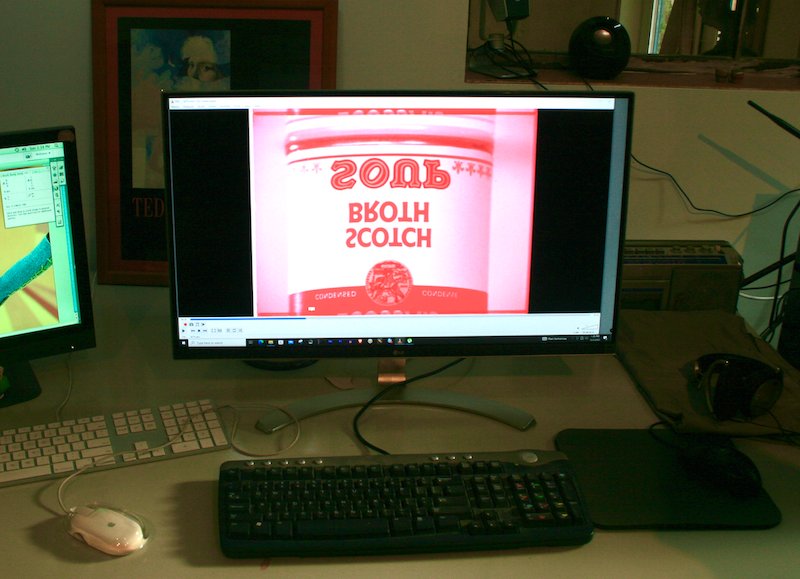
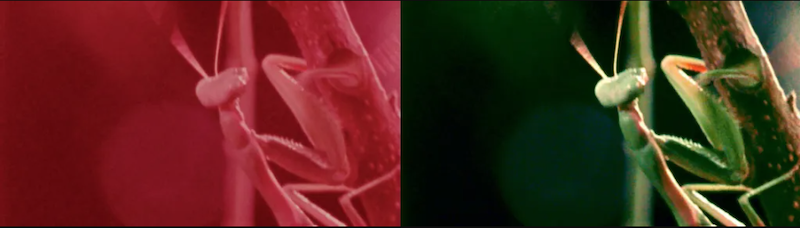
“Once the film is digitized, then you can really go do a full on assault of restoration, get rid of dust and scratches.””On the film scanner itself, we get something called dye fade. Over time, the dyes on the actual film emulsion will fade , leaving you with a pink image, like we’ve got here on the screen. The film scanner can bring back a lot of the original colour to probably about 90 percent of the dye fade that’s actually lost.”
He pointed to one of the images on his computers (top of page).
“This image was from a project that was scanned from, I believe it was probably a four by five negative. I can’t really recall, but that was for a children’s book that was published a few years ago now. What the artist had done is created these little sets with puppets and backdrops and photographed them. I took the photographs and scanned them, basically, and got them ready for their book to be printed. Some of the detail in the fabric and in this little puppet’s hair is really quite sharp and that was the advantage of the old drum scanners, you could get quite a sharp image.”
The adjoining computer screen displayed the picture of a woman who was intently working on something in front of her.
“That image I have on the screen there, that was from the university archive, and it looked like an incomplete project. In fact, it was just a mishmash of found film. I think somebody wanted to get their project handed in and just spliced together a whole bunch of garbage, really.”
It turned out that Doug works with new films as well as old:
“There are some filmmakers in Victoria that are just wrapping up a full length feature (called Lunar). So, I’m expecting to get some 35 mm film from Victoria in the next couple weeks. That should be a fun project.”
Ramsey at Sublunarfilms subsequently emailed Doug McCaffry:, “We shot on film as much as we could within our budget – if we could have done it all on film we would have. And Needless to say, you’re our go to person for scanning! Speaking of, I’m sending you a roll of 35mm and two rolls of super 8 to scan – the last of our Lucid material for now.”
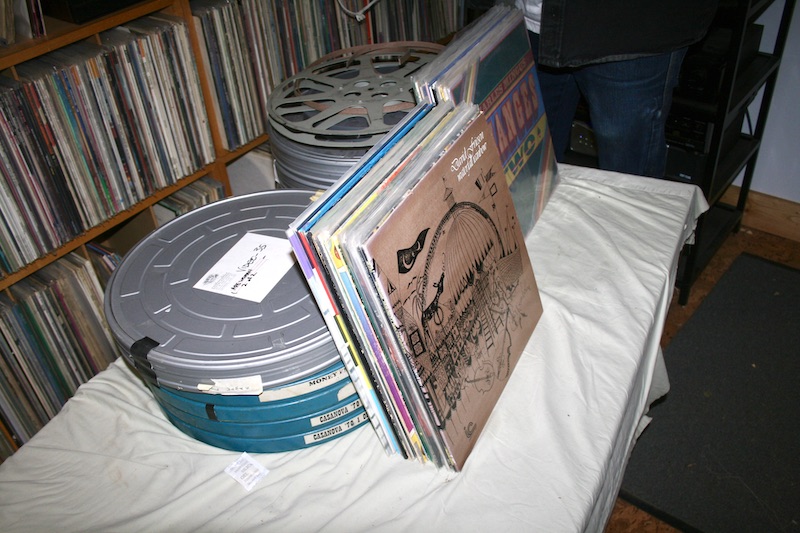
Our tour ended at some shelves full of records.
Cortes Currents: What are all these records doing here?
Doug McCaffry: “Apart from listening to them, I quite often will digitize them and make a WAV file or an MP3, that sort of thing. Just another way of preserving these old LPs, I guess you could say this is my analog playground.”
Cortes Currents: There’s a box of my father’s old boating movies in our spare bedroom. I don’t think anyone has watched them for decades and I brought one of the reels over to see what Doug could do with it.
Doug McCaffry: “We’re going to see what’s on it. It’ll go on the film scanner for sure.”
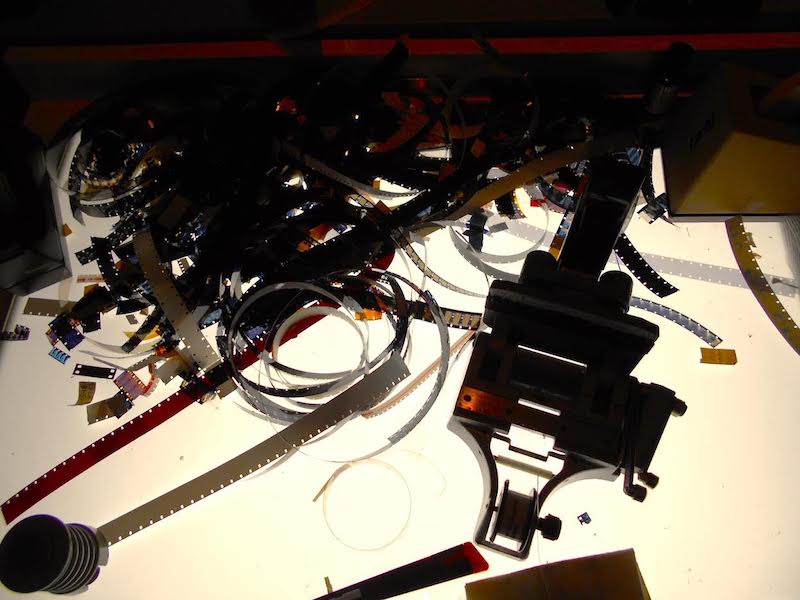
Cortes Currents: It seems so tiny compared to the machine?
Doug McCaffry: “We’ve got little reels we can put it on. Quite often when I get a lot of 8 mm film, I’ll splice them together to make one big reel. That saves you from going back and forth and changing reels every three minutes or five minutes or whatever. I’m estimating you probably have about three minutes of film there . Excited to see what’s on it. How far back does it go?”
Cortes Currents: It’s from my dad’s boat, the Play-a Day. It’ll be probably the 60s or 70s. I’ll bet it’s 60s.
Doug McCaffry: “60s? – that was the golden age of 8 mm film.”
Cortes Currents: Is that what that is?
Doug McCaffry: “Yep, 8 mm. Super 8 came out in the late 60s, and it’s basically the same idea, smaller sprocket, so you get a slightly larger frame. Back in those days it was 4 3 aspect ratio, you know, same aspect ratio as the old black and white TVs kind of thing. They didn’t have widescreen.”
“It’ll be exciting to see what’s on your little reel of film. It is for a lot of people. They find their grandpa’s burlesque collection in the crawl space. It’s quite an exciting time for these families to sit around and see what grandpa was up to back then.”
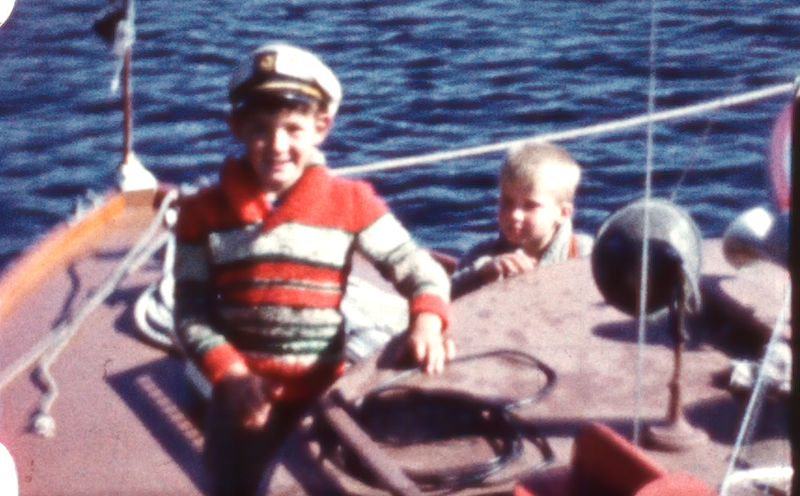
Cortes Currents: I was amazed to see how closely my eight year old self resembles one of my granddaughters and I have no memory of christening my father’s boat in 1959. My mother was only 39. I can only dimly remember the years when she was still a brunette. She’s so skinny in this movie! A number of people that I once knew were in the film, but also younger.
I could have asked him to restore the film so that the blemishes disappear. Doug mentioned you could make a resolution that would be suitable for playing at Manson’s hall. I laughed at that suggestion, though upon reflection it might work for a family reunion, albeit not at Manson’s.
Since then I’ve picked up another half dozen reels which my family might want to see.
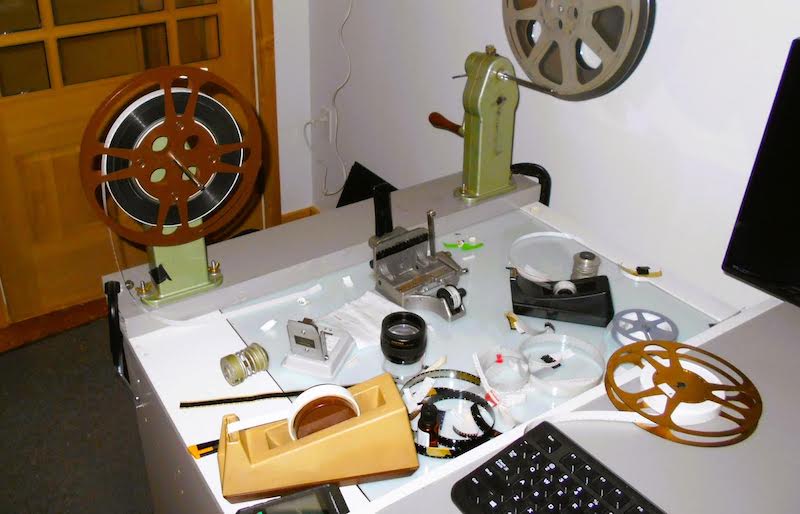
When people think of a film, they think of old and the past. Is there a future for film?
Doug McCaffry: “Funny you should ask that. Kodak can’t keep up with motion picture film orders right now. If you try to buy 60 mm film, you’re on a waiting list. All the directors in Hollywood are buying up 35 mm film and they’re just releasing a brand new 8 mm film camera. Can you believe it! So that’s good news for film.”
“In fact, these new 8 mm film cameras are going to have sound, they’re going to have a little LED display, you can monitor what you’re shooting. They’re not cheap. I was reading in the 1960s an 8 mm movie camera was about $55, well these are going to be about $5,000. So you’ve got to be quite the enthusiast with deep pockets, but the good news is a lot of young filmmakers are discovering film and I think that’s very exciting, and I think film definitely has a bright future.”
Links of Interest:
- Doug’s website: https://cinegraph.ca/
- Doug’s other website: https://thescanlab.com/
- George Sirk & the Cortes Film Festival
Contact Info
Tel: 250 935 0181
email: [email protected]
This post was originally made Dec 17 and republished Dec 18 to align with Cortes Currents weekly schedule.
Top image credit: A peek inside Doug Caffry’s studio – Roy L Hales photo
Sign-up for Cortes Currents email-out:
To receive an emailed catalogue of articles on Cortes Currents, send a (blank) email to subscribe to your desired frequency:
- Daily, (articles posted during the last 24 hours) – [email protected]
- Weekly Digest cortescurrents – [email protected]