
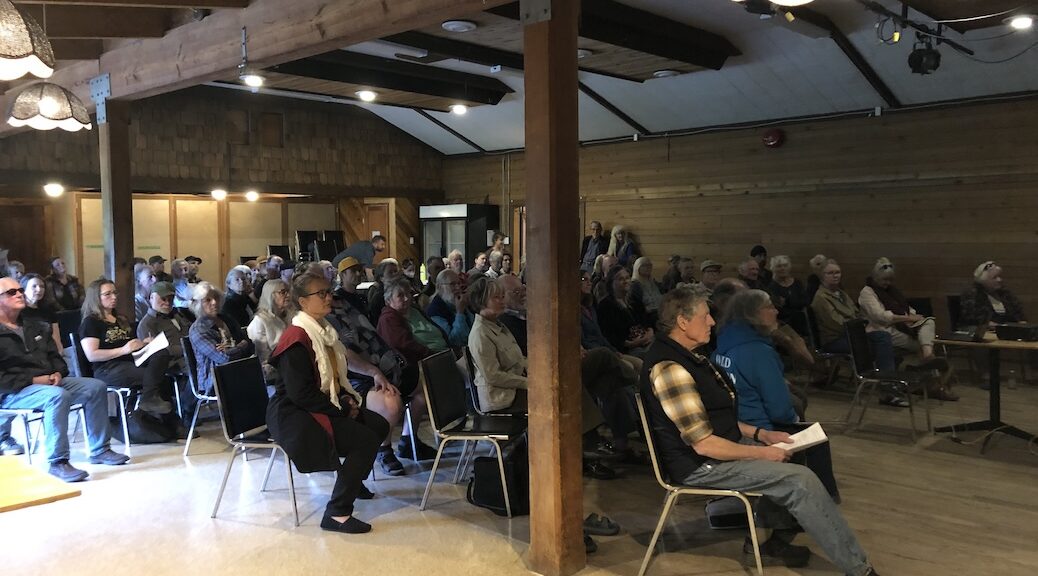

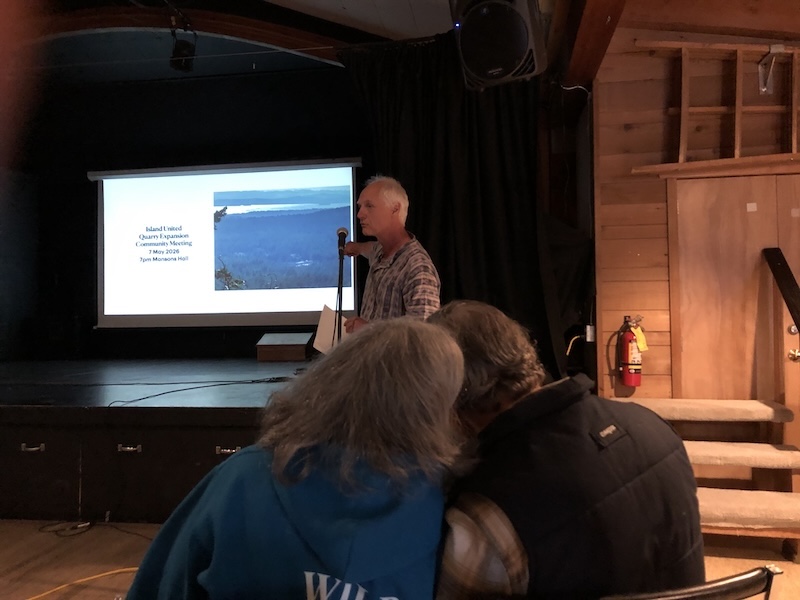
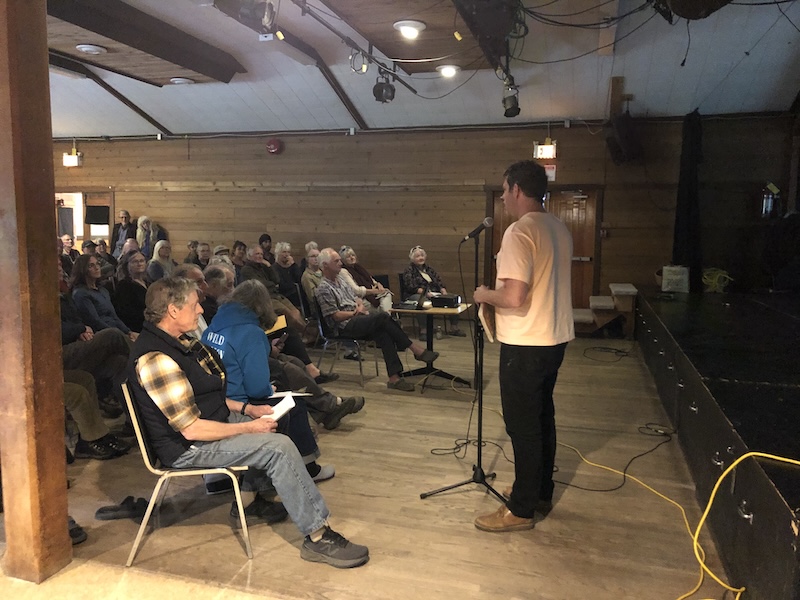
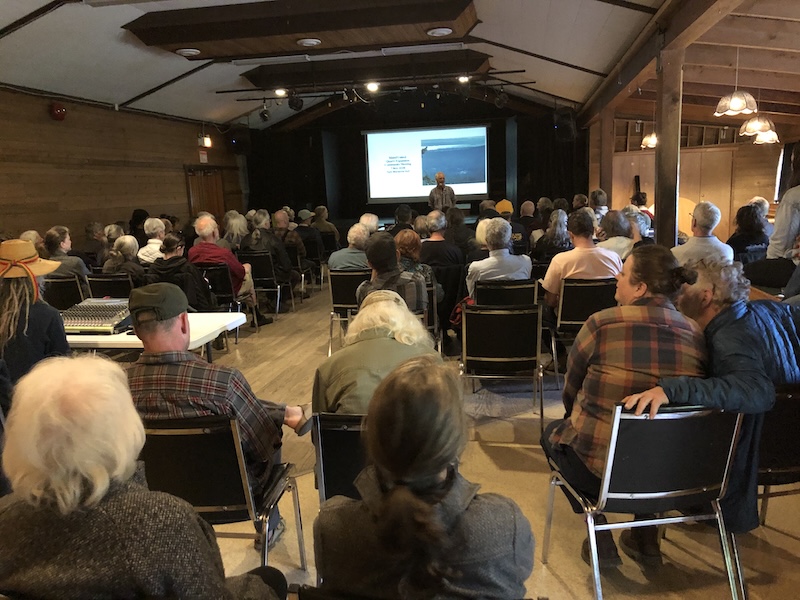
Around 100 people packed into Mansons Hall on May 7, 2026, for a community meeting on the proposed expansion of the Island United Quarry on Cortes Island. While most appeared to be opposed to the project in its current form, some added that Cortes Island needed a smaller quarry more in line with the island’s needs
Neither Howard Nielsen, who owns Island United, nor his wife were present. Regional Director Mark Vonesch explained, “ It’s their 15th wedding anniversary and they’re on a trip.”
Mike Moore, who MC’d the event, added, “First of all this is a meeting that is for information. We’ll have a question and answer period at the end of a few little presentations. It’s not a protest by any means. No profanity (audience chuckled); no derogatory comments. We’re here to look at the Island United Quarry expansion in Whaletown.”
(26+ minute Cortes Currents Radio program above, unedited 94+ minute audio from meeting below)
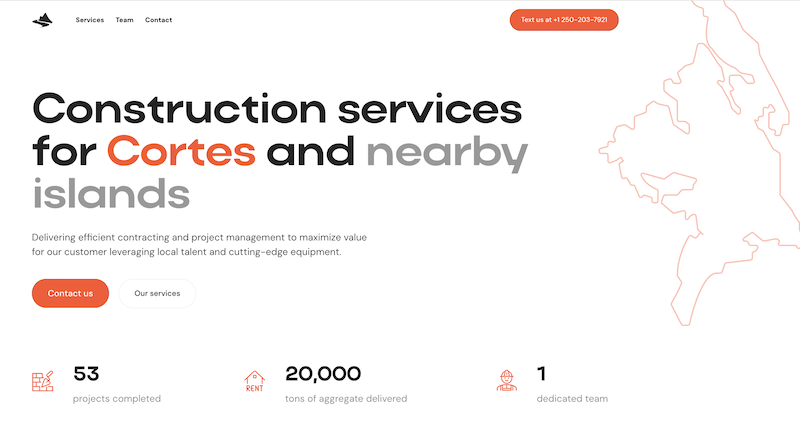
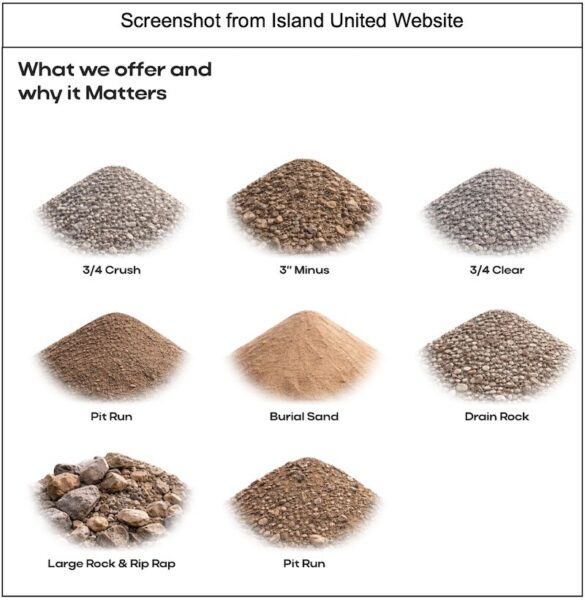
The tagline on Island United’s website (above) is ‘Construction services for Cortes and nearby islands.’ They offer infrastructure services ,’from the roads we drive to the systems that bring water to our homes.’
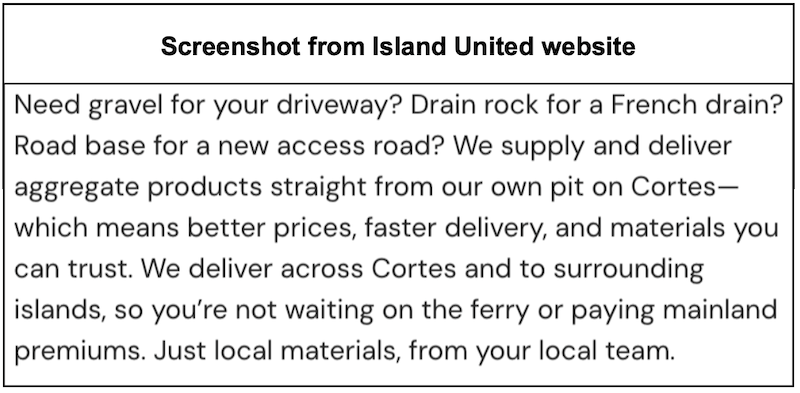

(Screenshot from Island United website)
Personal Opinions of the Application
De Clarke (Whaletown):”I don’t know anyone who thinks we don’t need gravel on Cortes. I don’t know anyone who wants to close down the pit. It doesn’t make any sense to bring in gravel by barges and ferries when we can produce it here. It’s damn heavy to transport. I think it’s a great pity that the old pit has played out. I think maybe it would have lasted a little longer if it hadn’t been used to fill and pave a certain runway (laughter), but that’s just my opinion. The pit’s played out. If we want any more gravel, the pit has to expand.”
“That’s not negotiable – But does it have to expand by a factor of four in footprint? And does it have to expand by a factor of six to 16 in output? That’s where I began to oppose this application. I looked at the numbers and they didn’t make sense to me. If there is a business plan that justifies these numbers, we should all be very concerned about it; and if there is no business plan that justifies them, then I have to ask why they were requested of the ministries. Why are they in the application?”
“So in my communication, I’m going to ask the ministries to reject this application until it is rewritten at a scale that is appropriate to the local market for gravel on Cortes Island.” (Cheers and clapping)
Cec Robinson (Streamkeeper, Whaletown): “The action items that we’ve asked for in our application include, amongst other things, professional biological and hydrogeological assessments; protection of water quality in James Creek and Hume Brook; zero herbicide use; and to please provide details of the gravel washing and the water disposal from washing that gravel.”
“In conclusion, we simply cannot support the existing management plan as it is written. There are fish-bearing waters on all sides of the quarry site, and they need protection. We recognize that Cortes needs the ongoing supply of gravel. Both of these goals could be achieved by scaling back the proposed expansion to perhaps one-half the proposed footprint and maintaining the extraction rate at approximately the level that we’ve seen on average over the years.”
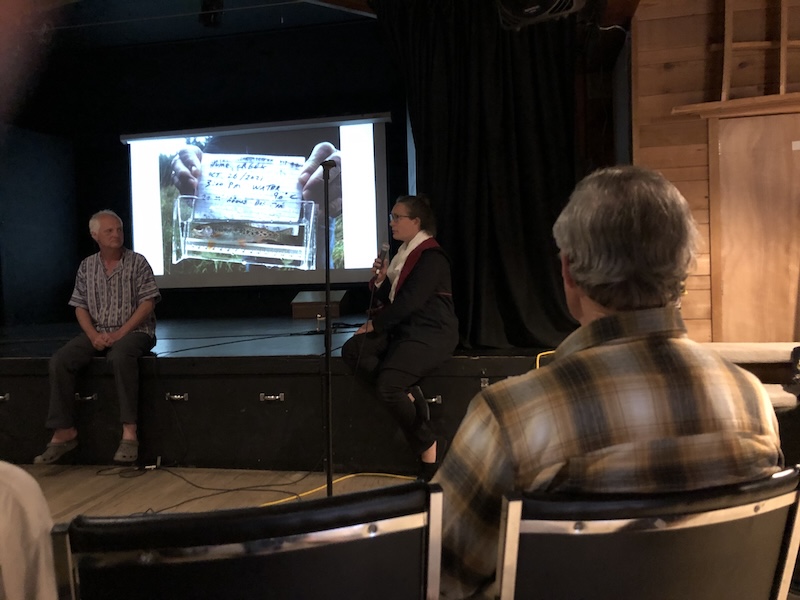
Noba Anderson (Former Regional Director, Whaletown resident) asked her successor:
“My request to you, Mark, as our representative, is to make a submission on our collective behalf—one that doesn’t speak to your opinion. It’s frankly irrelevant what you think…” (laughter). “In this job, which I had, it’s probably irrelevant (Someone responds, ‘yeah’), but it speaks to the collective wisdom of this community over the last decade and a half in all of those various planning initiatives. See if there are any places anywhere that speak to an aspiration that looks anything like this, because I don’t think you’ll find it. I don’t think anywhere in any of those planning processes we say we want a level of development at this scale for anything, whether it be mining, forestry, shellfish, or a rubber ball making factory.”
Director Vonesch (Regional Director): ”You’re right. The OCP doesn’t point to anything. I think scale is the big issue. if we were looking at an application that was a moderate increase with some reference to science and data around the environmental impact, we might have a much smaller amount of people in this room right now.
De Clarke: ”I’ve talked to at least one person in the community who I respect as a very sensible, well-informed individual and good community member and he’s not very concerned about any of this. To paraphrase our conversation, he more or less said, “I wouldn’t worry too much about these numbers. People just make up these numbers when they’re applying for permits *someone chuckled). Nielsen can’t possibly mine any more than he can sell locally. The markets on the other islands are sewn up, and his gravel isn’t that great anyway, it’s not top-grade stuff. So there’s no business case for exporting it.”
“He could be right, but if my neighbour wanted me to sign a piece of paper that said I gave him the legal right to burn my house down and then he said, “Don’t worry about signing it. Trust me, bro, I’m never gonna do it.” (clapping) I’d be like, “What?” I don’t know about you, but for me, “Trust me, bro,” just doesn’t cut it for something this important.”
Consulting with First Nations
Maureen Williams (Tiber Bay): “ I noticed in the application that they acknowledge their expansion would be into land that is a consultation area for three First Nations. Are they doing consultation with First Nations? Does anybody know how our Klahoose First Nation feels about this application?”
Director Vonesch: “I believe consultation has been done with Klahoose and I know Klahoose has used Island United for a lot of their buildings.”
He did not know anything beyond that.
The Application’s Incorrect Facts
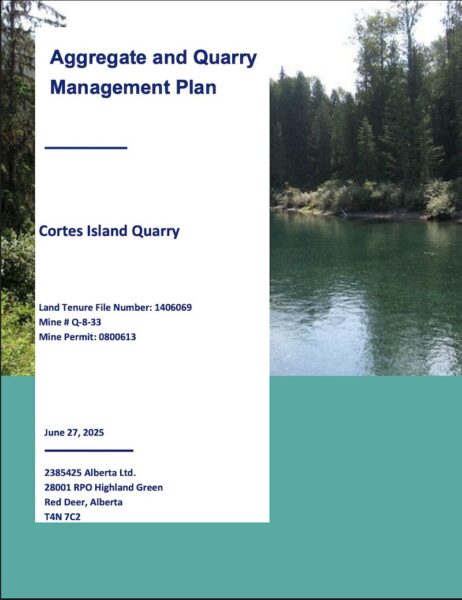
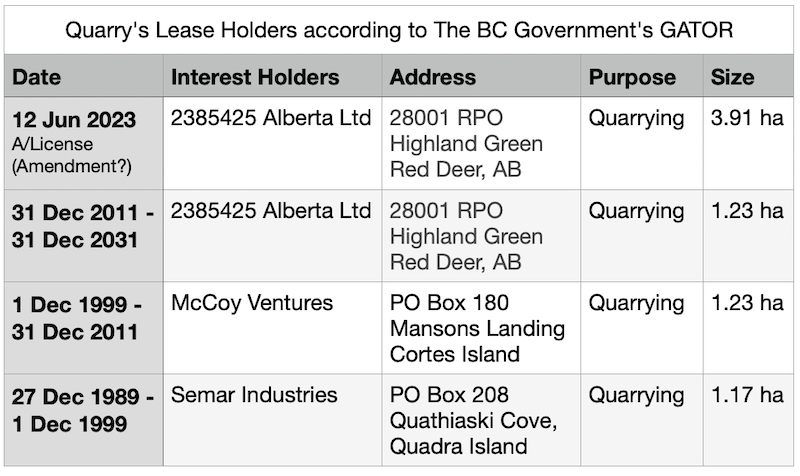
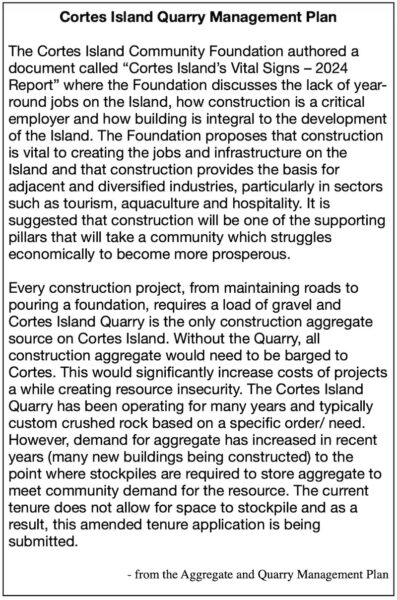
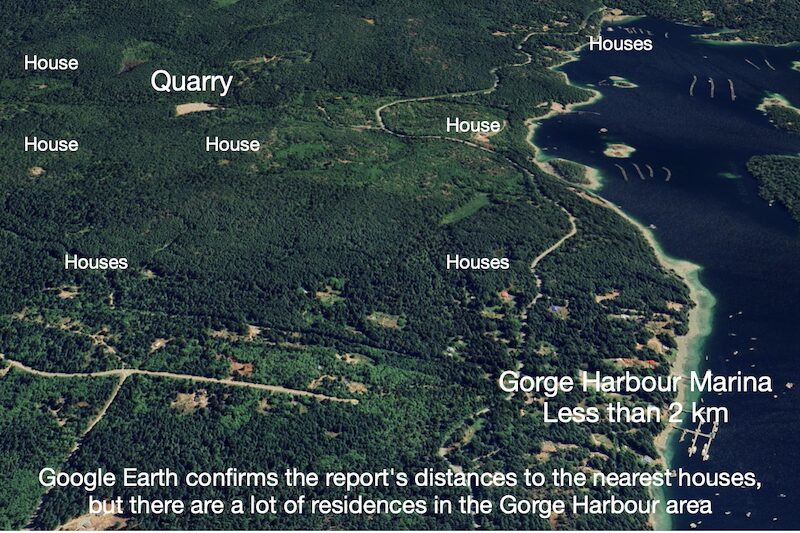
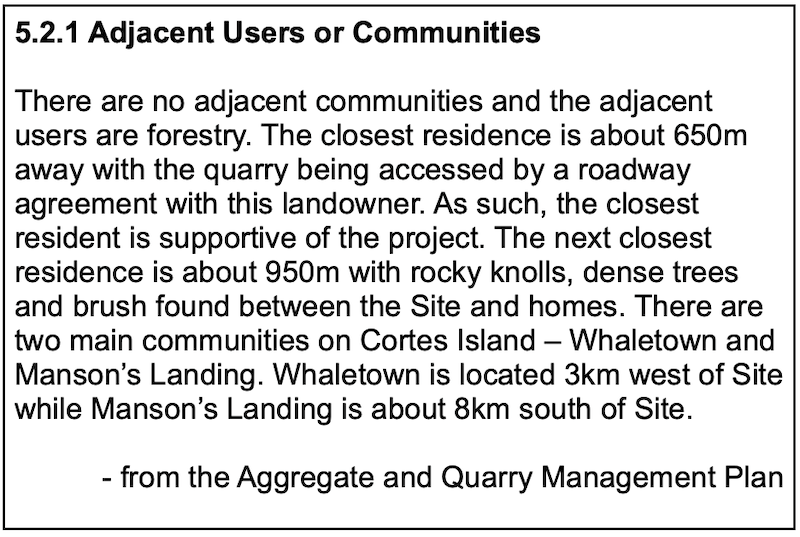
Kim Phillips (Whaletown): ”I have so many questions and issues with this application, but I think my main one is there is so much misinformation in the application as it sits. It says there’s no OCP. It vastly misrepresents the Cortes Island Community Foundation’s Vital Signs report to make it sound as if the Foundation is clamouring for us to build all kinds of stuff on the island. It says there are no fish-bearing streams anywhere in the area. It says Whaletown is three kilometres west of the site, and Manson’s is eight kilometres east of the site, and there’s nobody living in between, essentially. (Someone in the audience was chuckling at this point) I think that’s really disingenuous, and if it’s intentional, that’s awful.”
Gabriel Dinim (Whaletown) suggested, “ChatGPT came online in 2022. That application was put through in 2023, and it was obviously written with ChatGPT (laughter) because it’s full of the mistakes that are typical of that early large language model. It was obviously never read or corrected by anybody after that.”
Alternatively, some of the incorrect descriptions of the area surrounding the quarry may have been applicable sometime in the past.
On their application, Island United claims the quarry is accessed via ‘Robinson Road,’ but as Kim Phillips told the meeting, ”There is no Robinson Road.”
Christine Robinson (Streamkeeper, Whaletown) responded that the Nielsens told her, “They did get some historical data that, in fact, ‘Jimmy Smith Way’ was called ‘Robinson Road.’ That needs to be verified, and I think we’ve got the museum working on it.”
The following passage is another example of dated information in United’s application:
“There is no Official Community Plan for Cortes Island. The Electoral Area ‘I’ (Cortes Island) Zoning Bylaw, 2002 governs the area and designates the lands as Forestry One (F-1).”
Cortes Island has not been ‘Area I’ since 2008, when the old Comox Strathcona Regional District was divided into what are now the Comox Valley and Strathcona Regional Districts. It became ‘Area B’ of the newly established Strathcona Regional District.
Cortes Island’s Official Community Plan (OCP) came into being four years later, in 2012. (In the unedited audio of this meeting, Director Vonesch discusses plans for a new OCP in 2027.)
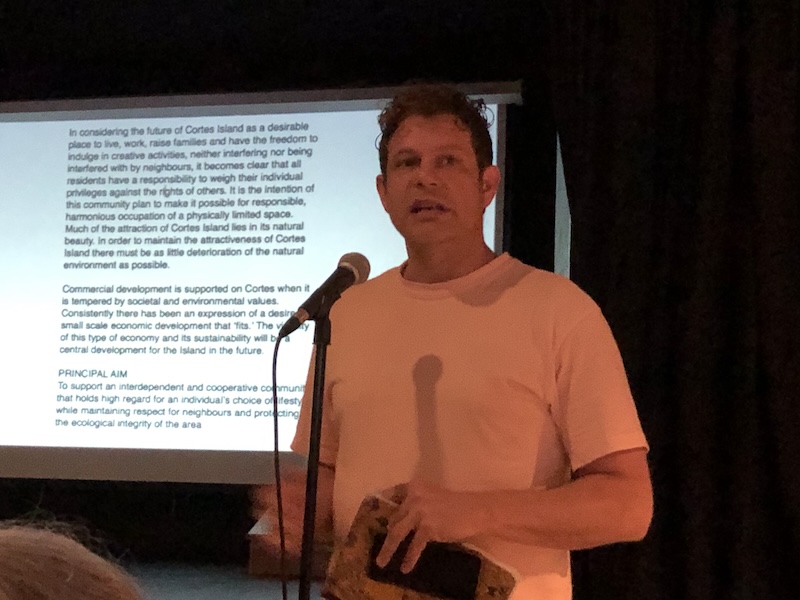
Excerpt from Cortes Island’s OCP
Mike Moore (Mansons Landing): “We have an OCP, and this really informs our dialogues here.”
He read out a passage to set the tone for the meeting.
“In considering the future of Cortes Island as a desirable place to work, live, raise families, and have the freedom to indulge in creative activities, neither interfering nor being interfered by– with by neighbours, it becomes clear that all residents have a responsibility to weigh their individual privileges against the rights of others.”
“It is the intention of this community plan to make it possible for a responsible, harmonious occupation of a physically limited space. Much of the attraction of Cortes Island lies in the natural beauty. In order to maintain the attractiveness of Cortes Island, there must be as little deterioration of the natural environment as possible.”
“Commercial development is supported on Cortes when it is tempered by societal and environmental values. Consistently, there has been an expression of a desire for small scale economic development that fits the viability of this type of economy and its sustainability will be a central development for the island in the future.”
“The principal aim of the OCP is to support an interdependent and cooperative community that holds high regard for an individual’s choice of lifestyle while maintaining respect for neighbours and protecting the ecological integrity of the area. – That’s really what we’re about tonight.”
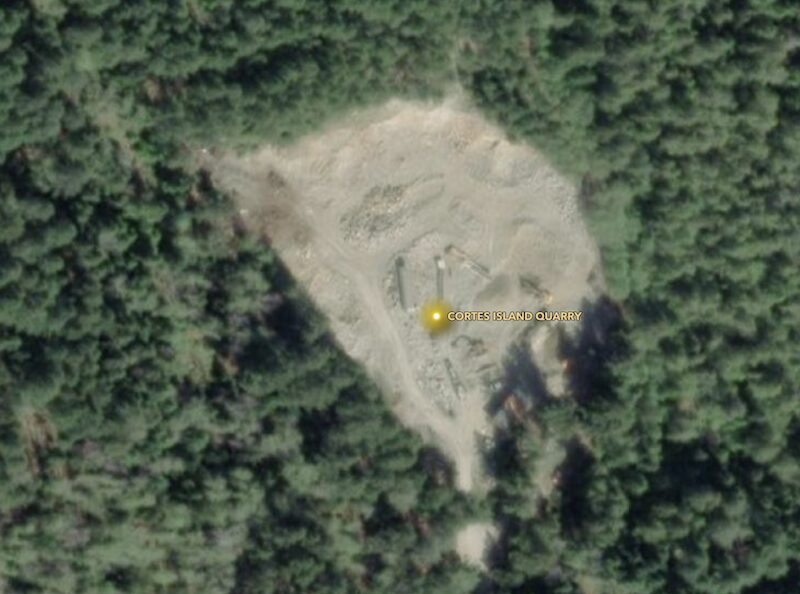
Deadlines for Commenting
Two Provincial Ministries are involved in the regulatory process. Anyone wishing to submit comments to the Ministry of Forests and Crown Land must do so before midnight on May 14. The original deadline for comments to the Ministry of Mining was May 8, but Director Vonesch announced a two-week extension. The new deadline for comments to the Ministry of Mines is now May 22.
Director Vonesch: “ I emailed the Ministry of Mining 10 days ago or so. Usually when you email a ministry, there’s a lot of silence. You have to follow up and chase it. It could be weeks before you end up getting a reply, and often it’s an auto reply, ‘Thank you for your email, we don’t have time to meet with you.'”
“ So I sent the email. Twenty minutes later, I get a phone call back from an old friend who happened to be the person who’s receiving the emails on behalf of the Ministry of Mining.” (Applause)
“I met with them this afternoon. One of the things that I’ve heard from the community is like, “Whoa, this feels really rushed!” So one of the things I asked them is to extend the deadline. I was told by my friend that it’s a long shot, but it’s worth asking. I just got an email an hour ago, the deadline has been extended for two weeks. ”
”I think that gives an opportunity for fairness, for more people to understand the issue, for more people to engage with the issue. Whether you support this project or you don’t support this project, having public consultation is really important. This is public land. This is land held by the government for the public, and we are part of that public.”
Someone asked if the application would be stopped if a percentage or a specific number of people opposed it.
Vonesch replied, ”No, I don’t think it’s a vote, it’s just weighing the arguments.”
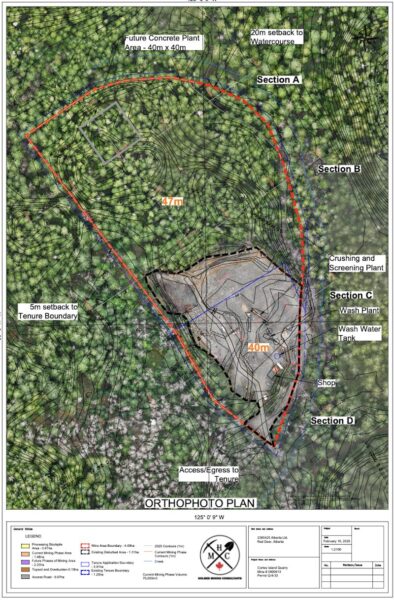
“It seems that the application is really about the quarry expansion, it looks like a four times expansion.”
“The application to the Ministry of Forestry includes potential water washing of the aggregate and the potential of a cement plant.”
Clarification: A Concrete Mixing Plant
De Clarke: “ I want to make it clear that we’re not talking about a cement plant. A cement plant is a place where you grind up limestone to make the powder for cement making, and you mix it with other ingredients, and it’s a very filthy plant. I have lived near a cement plant in my time, a lot of dust and a lot of noise. He’s talking about a concrete plant, which is where you mix the ingredients to make concrete. So mixing the aggregate with the limestone powder and the water and the other, and the sand and other ingredients.”
“But the interesting thing about having a concrete mixing plant here is that there’s no limestone on Cortes. If there’s a geologist in the room you can correct me but, as far as I know, we’re in the Cordillera here. There’s no limestone on Cortes, and I don’t think we have a sand quarry. So the two big ingredients, limestone and sand, would have to come in from outside. They would have to be transported in, so that’s more truck trips.”
Feeling the thump, Windows rattling
“ I live in Whaletown. My driveway is about a kilometer west from where Jimmy Smith Way, which is the quarry driveway, intersects with Whaletown Road. When there’s been major blasting at the pit: I feel the ‘thump,’ as well as hear the ‘kaboom’ in the distance. My southern property line is Whaletown Road, so when heavy trucks go grinding their way up the hill from Robertson to Boddington, my windows sometimes rattle a little. So I do have an interest in this question, and when I heard about the quarry expansion, I got curious and I read the documents.”
The Numbers
“What usually catches my eye is numbers, I pay a lot of attention to the numbers. I’d like to talk a little bit about some of the extraction rate numbers in the permit application because they’re a bit puzzling.”
“ There’s one in the permit language in the application online at the Ministry of Mines website, and it says that the extraction would be permitted up to a maximum of 40,000 cubic meters per year. If you go through the conversions, that’s about 78,000 short tons. Then the management plan sets a different upper limit. 39,999 metric tons, which is approximately 44,000 short tons. Then there’s another number, which is a projected average annual extraction rate in the management plan that is 14,545 cubic meters, which is about 24,000 short tons. So we have three different numbers, two maxima, one of which can’t be right, and one average.”
“Then there’s a fourth number that I think we should think about, the historical extraction rate, and that we can guesstimate from Island United’s website, where they say ‘we’ve shipped about 29,000 tons of gravel over the last four or five years of operation.’ So we can guess that it’s maybe 4,000 or 5,000 short tons a year.”
“If this permit is approved, Mr. Nielsen or anyone he ever sells this quarry to in the future would have the legal right to extract almost eighty thousand short tons of gravel every year. Now, I don’t know why anyone would want to do that unless they have an off-island market in mind because this is an enormous amount.”
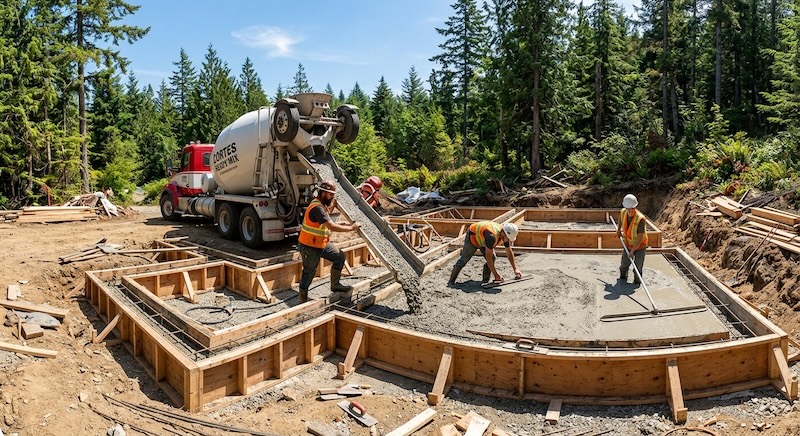
“The local market cannot possibly absorb even a fraction of this. And if you consider it solely as an ingredient for concrete, which isn’t realistic but it gives you a little proportion, that’s enough concrete to build over a thousand foundations and hundred-yard driveways for two thousand square foot family homes a year.”
Ron Bowen (Whaletown): ”This is Mr. Google, I looked this up. Depending on the material that you’re crushing, to crush 42,000 cubic yards would take between 55,000 and 72,000 gallons of diesel. (Nervous laughter, several people say ‘wow’) That’s a lot of smoke, that’s a lot of s___ in the air and then they’re going to truck it at 4 miles to the gallon, diesel.”
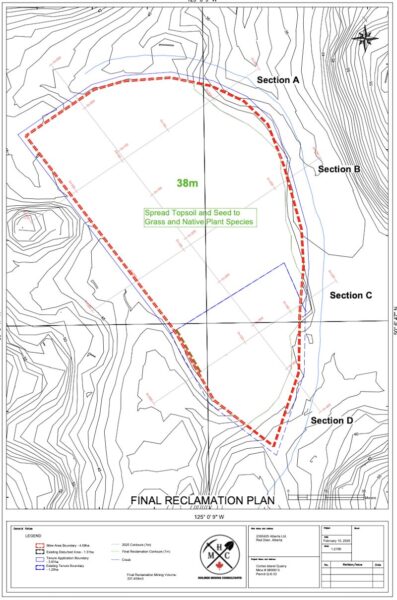
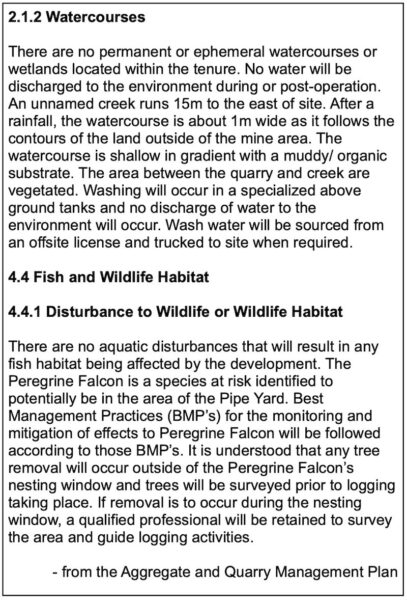
Screenshot: 2385425 Alberta Ltd submission to Ministry of Crown Lands
Mike Moore: ”One number that really struck me was the 30-year life expectancy before they put the pit to bed and turned it back into forest land. Where the heck are we going to get our gravel after 30 years?”
Water Matters
Sherman Barker (Mansons Landing): ”I’d like to know how much fresh water they require for the gravel expansion? Where is it going to come from?”
De Clarke: “Some of the math I did with the retired geologist suggested 2,700 gallons a day might not be out of scope, like one large water truck a day.
Sherman Barker: “So I would ask that to more knowledgeable people like Cecil and Christine. Where would you see 2,700 gallons of water per day coming from?”
De Clarke: “In the management plan, it actually states explicitly water would be obtained from an off-site license and trucked into the site.”
Director Vonesch: “I called the Nielsens and I’ve emailed them a couple of times. I didn’t get a clear answer on the water. They said that there’s two ways to do it. One is through a closed system, which I still don’t understand where that water would eventually go. Then the other is a pond where the water would go and the particulates would settle.”
Christine Robertson: ”As a stream keeper, having looked and walked the area, looked at the maps: where a tailing pond would go that could not somehow affect stream health, fish health is a question that defies my understanding.”
A Multitude of Wetlands and Creeks
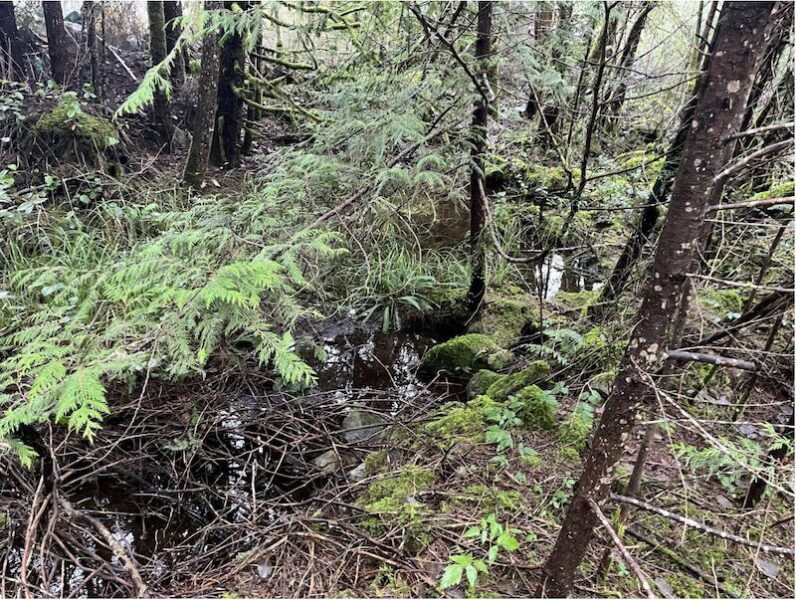
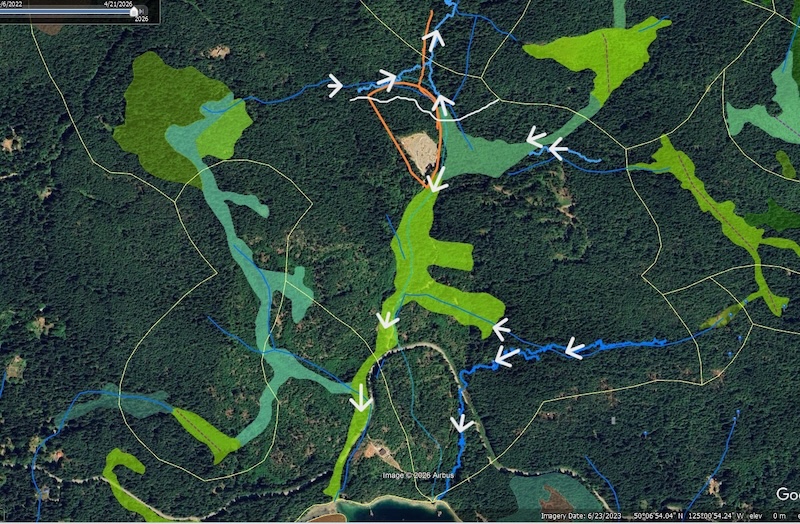
“There is a whole network, not just of streams, but wetlands on all sides around the existing quarry and the proposed expansion. James Creek is our largest watershed on Cortes Island. Then flowing south directly south from James Creek is Hume Brook. Apart from having fish in it, Hume Brook actually has two active water licenses and three homes that rely on the water supply. It also flows into the Gorge where there’s a major aquaculture industry. So the other little creek that’s of note we are calling Quarry Creek because it really skirts the northern end of the expansion, and it flows into James Creek.
Cec Robinson: “ The James Creek headwaters are prime habitat for juvenile cohos who would spend the first year of their life in freshwater. Quarry Creek flows into James Creek directly east of the existing quarry. By definition, that makes Quarry Creek a fish-bearing creek.”
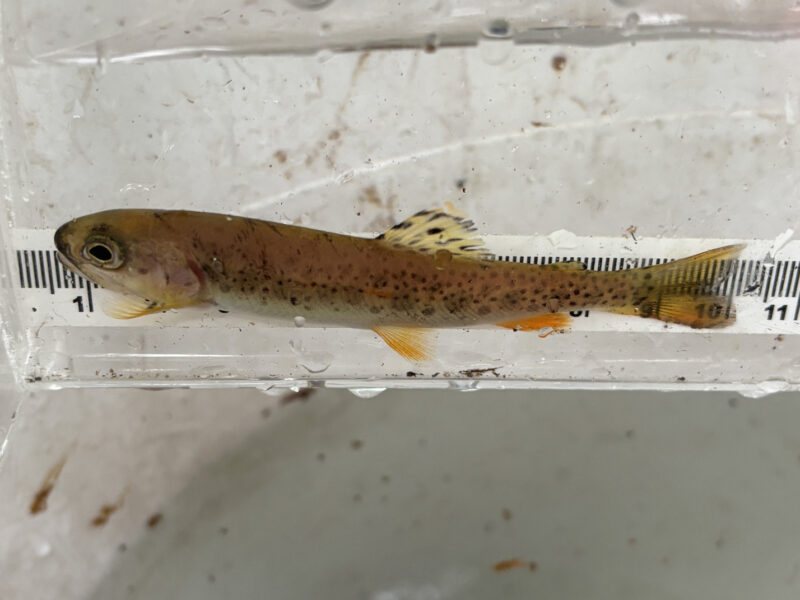
Christine Robinson: “We have cutthroat trout throughout all of our creeks, including the tiniest creeks and all the wetlands in the immediate area around the quarry.
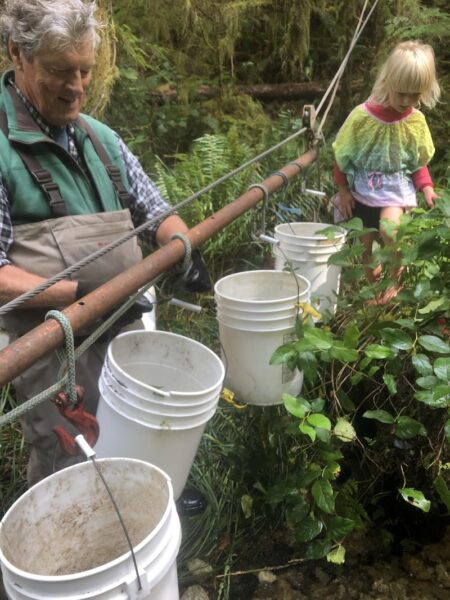
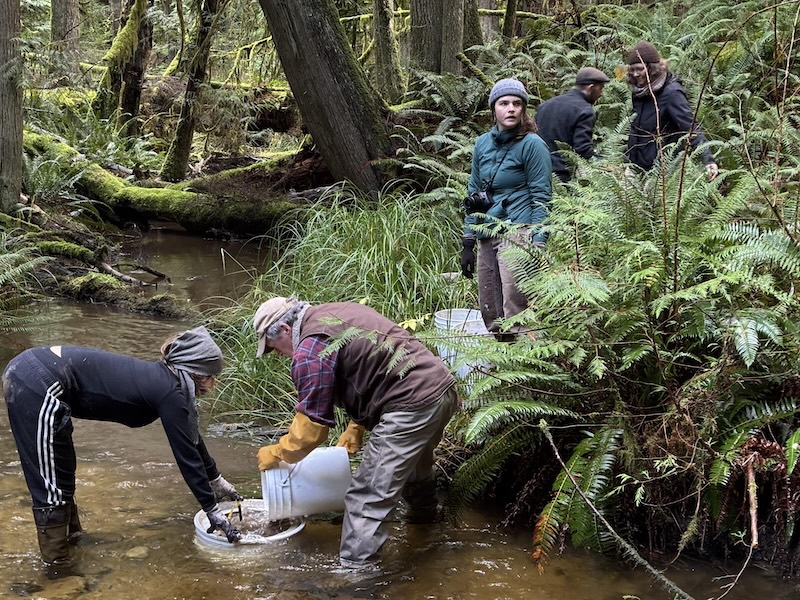
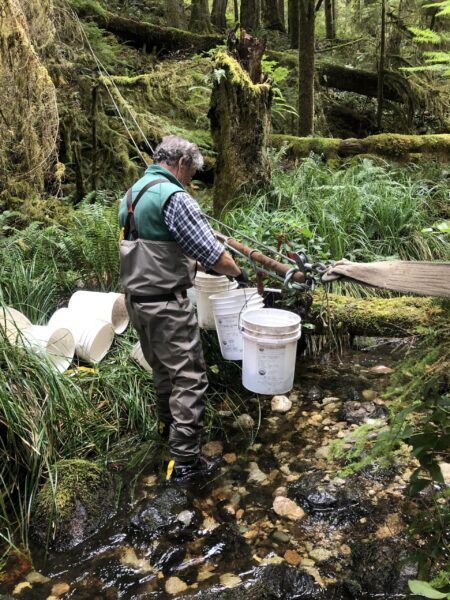
Cec Robinson: ”The James Creek Gravel Project deposited spawning gravel into James Creek, from 2021 to 2025, to enhance the existing spawning area. It was a multi-partner effort, approved by DFO and with the cooperation of Mosaic Forest Management. There were 48 Cortes volunteers. We moved 7.5 tons of spawning gravel several hundred metres down into that creek using buckets, wheelbarrows and a zip line.”
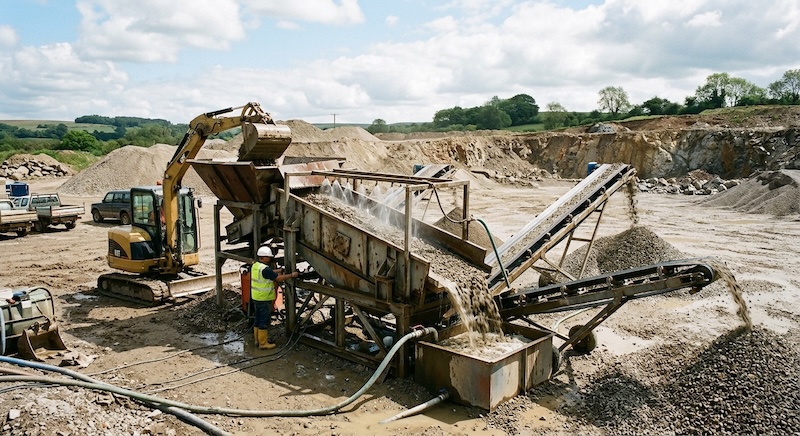
(Gemini AI image of a small gravel washing plant)
Washing the gravel
Peter Henbury (Whaletown): “What are the effects of the current gravel pit on the watershed, in terms of the washing of gravel and so on and so forth?”
Christine Robinson: ”Given that we’ve got very healthy numbers of cutthroat and cutthroat are only found in streams that are considered very healthy, I would say that it’s not had much impact – but I don’t believe they’re washing the gravel.”
Jane Newman (Mansons Landing): ”If we don’t already wash it, why start?”
De Clarke: ”If the aggregate is washed, it’s a higher quality product and that works better for things like foundation pouring. This is anecdotal, but it’s from a reliable source: when Telus came here to do the base for the tower, they chose not to use gravel from the pit because it was what they call dirty gravel. It doesn’t form that great a bond with the rest of the concrete ingredients. They obtained gravel from outside Cortes. This is also true of several of the extremely affluent residences on the island. They have actually brought gravel in from Texada by barge because it’s clean gravel. So presumably, Island United would like to install washing equipment because they would like to raise the market value of their aggregate.”
Dancing Wolf (Tiber Bay): ”I drove a gravel truck for nine years … I know a lot about gravel. One thing that was mentioned is the dirty gravel in the pit. If you have any kind of slope, and a lot of us do, that gravel doesn’t bind very well. It’s not just in foundations, it doesn’t bind in the road either.
The Trees
Jeremy (Whaletown): ”I don’t think this is about gravel at all, I think this is about the trees. What we’re talking about here is logging Carrington. I don’t know how many people remember the last time that they tried to log Carrington, we ran off Island Timberlands. I feel like we could probably handle these people.” (laughter and cheers)
He suggested that Island United will simply expand the quarry, sell it and then move on to make their mess somewhere else.
Jeremy: “My question, after I say thanks to you guys all for setting this up, everyone for coming, is Cortes still socially inoperable?” (applause)
(This refers to a comment Island Timberlands allegedly made after Cortes Island’s 2012 logging blockade. “Island Timberlands walked away saying Cortes was socially inoperable.”)
Jude (Mansons Landing): “Does the leaseholder own all of the logging rights for the extended boundary that they want and will profit from that?”

Mark Lombard (General Manager, Cortes Forestry General Partnership): ”Basically, if you’re applying for a subsurface license, so a mining license through the Mining Act, once you’re granted that license, it trumps the surface rights. The mining license can do whatever they want in the license area of the community forest. They don’t have to inform the community forest or request permission or anything like that. It’s a higher level authorization, but they’re not allowed to use the logs. and they’re not allowed to sell the logs or otherwise do anything with the logs.”
“The plan is to cut them down and then for the community forest to get the logs to market. I think in this case, most of the logs that would be harvested would go to the plywood mill in Nanaimo.”
Traffic and Dust
Kate Maddigan (Mansons Landing): “ How is this gravel going to get to the market? Is it going to be plugging up our ferries and taking away from the quality of our roads. I think it’s worth pointing out that Cortes Islanders have said over and over again that they want our roads to be safer for active transportation.” (active transportion means things that require physical exercise: walking, jogging, cycling etc),
Leona Jensen (Whaletown): “As a cyclist on the island, I’m really concerned about increased numbers of trucks on the road. They go really fast. And some places there’s no place to get off the road. So somebody’s gonna get killed. I think it’s important to have gravel, but I think it’s also important to promote environmentally positive things like cycling.
Gary Cork (Mansons Landing): “I have lung problems, and I don’t know if there’s any study done on Cortes, the number of people have lung problems, and if this goes through- we’re gonna have a lot more lung problems.”
Tips for Writing the Ministry of Mining
Director Vonesch gave some tips on contacting the Ministry of Mining. He suggested that people be kind when they write to the Ministry because ‘these are good people on the other end, trying to make good decisions, and they do actually care.’He stressed the need to write about things within the scope of the project.
“If you write a letter saying, ‘This is going to plug up the ferries because I think that they’re going to export aggregate to Quadra’ – that’s not something they’re considering.
“When you are writing in, whether you support it or not, it’s speaking to the impact of the project environmentally. If you’re a neighbour: how noise or dust might impact you. Public safety: that’s another one; And engagement.”
Generally in these applications, the proponent is responsible and often takes a big lead on engaging the community. I think that was part of the reason why the ministry extended the deadline, because there was a lost opportunity for that to happen.”
Contact Information for the Ministries
Ministry of Forests
Deadline: May 14th, Midnight
- Focus Areas: Impact on roads and ferries, tourism, quality of life, and community engagement.
- Public Portal: Click Here
- Email: [email protected] with a copy to Island United, 764 Whaletown Road, Cortes Island, BC V0P 1K0 and/or [email protected]
- Mail: Campbell River Natural Resource District, 370 South Dogwood Street, Campbell River, BC V9W 6Y7.
Ministry of Mining and Critical Minerals
Deadline: Extended to May 22nd, Midnight
- Focus Areas: Environmental impacts, watershed protection, water usage, contamination/leaching, noise, and fish presence.
- Public Portal: Click Here
- Email: [email protected] with a copy to Island United, 764 Whaletown Road, Cortes Island, BC V0P 1K0 and/or [email protected]
- Subject Line: Cortes Island Quarry – Mine #1610613
- Note: Include “Formal Objection, Mine File 1610613” in the body of the email.
Links of Interest:
- Island United: Construction services for Cortes and nearby islands (website)
- Aggregate and Quarry Management Plan – 2385425 Alberta Ltd.
- Fishy Business: Cortes Streamkeepers opposed to quarry expansion plan – Cortes Currents
- Quarry Expansion Plan Numbers, Inaccuracies Questioned – Cortes Currents
- Island United Seeks to Expand Quarry – Cortes Currents
Top photo: May 7 Community Meeting; All undesignated photos by Roy L Hales.
Additions: Much of the material on Island United was added on the morning of Monday May 11.
Sign-up for Cortes Currents email-out:
To receive an emailed catalogue of articles on Cortes Currents, send a (blank) email to subscribe to your desired frequency:
- Daily, (articles posted during the last 24 hours) – [email protected]
- Weekly Digest cortescurrents – [email protected]