

As the course of history attests, civilizations tend to rise and then fall. This process poses two fundamental questions. What causes people
to coalesce into complex societies? And what causes them to fracture
into disorganized populations? Perhaps the most cogent and credible of current explanations to both their formation and collapse is in Goliath’s Curse: The History and Future of Societal Collapse, a remarkably insightful 2025 book by Dr. Luke Kemp, a scholar from the Centre for Studies of Existential Risk at the Cambridge University.
All posts by Ray Grigg

The Quadra Project: A Moment for Methane
Carbon dioxide (CO2—a single atom of carbon with two attached atoms of oxygen) gets most of the attention as the cause of global warming
because it can persist in the atmosphere for centuries. Methane is a
gas (CH4—a single carbon atom with four attached atoms of hydrogen)
that deserves attention, especially because every portion of a degree
is crucial in avoiding the worst consequences of global warming.
Although methane persists in the atmosphere for only about 20 years,
it is about 80 times more warming than carbon dioxide, so its
importance in the short term is critical. “Cutting methane is the
single most important strategy in slow near term warming,” says
Durwood Zaelke, the president of the Institute for Governance and
Sustainability (The Guardian Weekly, November 21, 2015). Its
pre-industrial atmospheric concentration was about 715 parts per
billion, and its 2025 level is presently measured at about 1930 ppb,
an increase of nearly 270%. Because of the short life of methane,
these high levels are maintained and increased by the continuous and
rising rate of emissions.
The Quadra Project – Gasoline
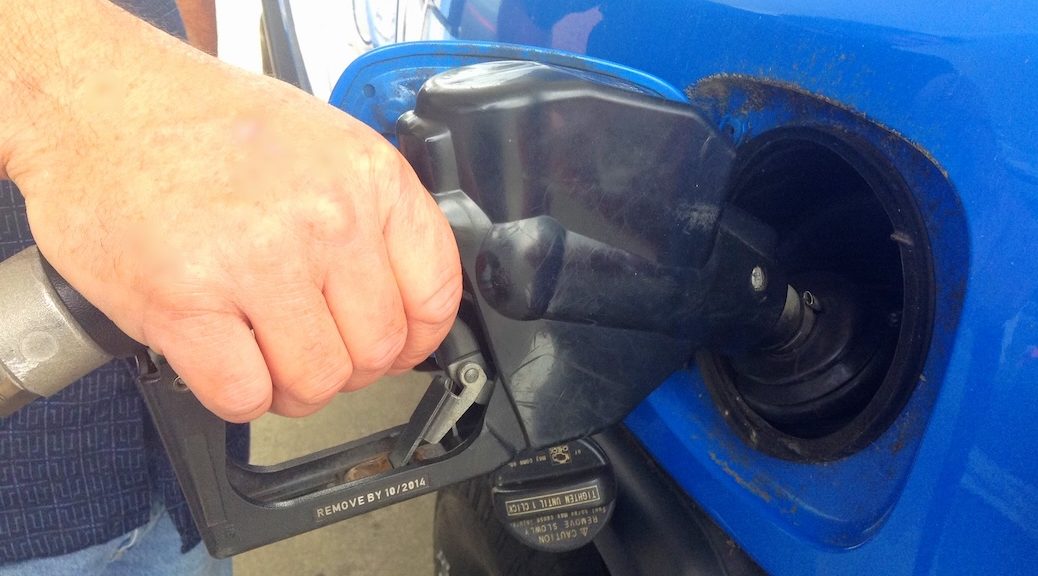
Driving a gasoline powered car is getting more expensive these days as a consequence of the war with Iran and the closure to most oil tankers of the Strait of Hormuz. Our industrial and consumer world is still largely energized and sustained by oil, and about 20% of the global consumption of about 100 million barrels per day must pass unimpeded through that narrow gap in the Persian Gulf. Limit supplies and the price goes up. So, while the subject of oil is current and the price of gasoline has our attention, this is an opportunity to consider the environmental implications of what we are doing as consumers of these fossil fuels.
Continue reading The Quadra Project – Gasoline
The Quadra Project: Invisible Enemies
Alpha Male – Photo by Art DiNo via Flickr (CC BY SA 2.0)
Anthropology reveals interesting information about ourselves, particularly because of its ability to conduct an examination of our human behaviour and customs from the distance of different cultures and long periods of time. This provides anthropology with an illuminating perspective that is available to few other sciences. An illuminating example of this is provided by “The Enemy Within”, an article in the July 12, 2025, edition of New Scientist, written by Jonathan R. Goodman. (Also see his book, Invisible Rivals: How We Evolved to Compete in a Cooperative World.)
As a sociologist, Goodman explores the interface between anthropology, primatology, psychology and economics to explain the dynamic of inequality. This has become particularly worrisome in our present culture as the rich get richer, the powerful more influential, and everyone else is feeling justifiably victimized. Goodman begins by taking us back to our very historical beginning.
Continue reading The Quadra Project: Invisible Enemies
The Quadra Project: Intelligence
In the back pages of New Scientist magazine, in a section called Almost the Last Word, readers pose questions that are then answered, usually by well-informed other readers. In the July 13, 2024 edition, someone asked, “Once life is established, is the evolution of intelligence inevitable?”
Garry Trethewey of South Australia attempted the first answer. “Probably not. Wings have evolved four times—in birds, bats, pterosaurs and insects. Legs and eyes have evolved multiple times. Swimming ability has also evolved many times. But intelligence has only evolved once, very recently. Is it useful? Is it a survival trait? Is it somehow better than not-intelligence? Given the 8 billion of us versus the vastly greater numbers of microbes and how long they have been around, I would put my money on the microbes.”
Continue reading The Quadra Project: Intelligence