Tag Archives: Campbell River

EXCLUSIVE: Hong Kong asylum applicants suddenly shun Canada. What’s happening?

Editor’s note: There are very few Chinese ‘immigrants’ in North Vancouver Island. Most new Canadians appear to be attracted to more urban areas of British Columbia, and our area is primarily populated by descendants of earlier ‘settlers.’ Most of the foreign born residents in our area reached Canada sometime prior to 1980. The 2021 census reports some Chinese immigrants in Comox (100), Courtenay (80), Powell River (55) and Campbell River (50). There were no Chinese immigrants reported on Cortes Island or in Area C

The vast majority of people who ‘look Chinese’ in our area, are actually Canadians. The numbers of people who stated their ethnic origin is Chinese are: in the Comox Valley (795), Courtenay (460), Campbell River (310), Powell River (200) and Area C (20). While no of Chinese ancestry was reported on Cortes Island, there could be 1 or 2 as Statistics Canada rounds numbers off to the closest multiple of 5.

One of the hindrances to immigration for Hong Kong mentioned below, is that it is a Cantonese speaking area and when Canadians speak a Chinese language it is usually Mandarin. This is not true of our area. Only 5 of the 20 people of Chinese origin in Area C speak a Chinese language: Cantonese. There are more Cantonese speakers than Mandarin in Comox (180 vs 110) and Campbell River (80 vs 65). There are almost equal numbers of people speaking these languages in Courtenay (110 vs 115). Powell River is the only place where Mandarin was used by the vast majority of people still speaking a Chinese language (60 vs 30).

Two other hindrances to immigration: difficulty finding high-quality work and lack of affordable housing.

By William Koblensky Varela, New Canadian Media, Local Journalism Initiative Reporter

Hongkongers have largely stopped applying for Canadian work and study permits under a policy for those fleeing the Beijing-imposed national security law, previously unpublished data from Immigration Refugee and Citizenship Canada (IRCC) shows.

Thousands of people from Hong Kong fled to Canada after China cracked down on dissent and free speech in the former British colony by imposing the national security law in 2020. Since then, many pro-democracy activists have been silenced, civil society groups have been shut down and outspoken media outlets have been closed.

However, a tough job market for new immigrants, housing challenges, competition from the UK and Taiwan, as well as a downturn in the Hong Kong economy could all be behind the sudden slowdown in asylum applications to Canada, according to expert opinion.

Continue reading EXCLUSIVE: Hong Kong asylum applicants suddenly shun Canada. What’s happening?

The door to B.C.’s liquefied natural gas export sector is about to open. Here’s what you need to know

Editor’s note: In February 2013, the Christy Clark government proclaimed “LNG development is poised to trigger approximately $1 trillion in cumulative GDP within British Columbia over the next 30 years.” Eleven years later, the list of ‘proposed or under construction projects’ has shrunk from 20 to 7. The only local proposal, Discovery LNG in Campbell River, is no longer on the list. 

According to Natural Resources Canada, “LNG Canada, in Kitimat, BC, will be Canada’s first large-scale LNG export facility once complete, aiming for first exports by 2025. The majority of the other projects target beginning operations between 2027 and 2030.”

By Matt Simmons, The Narwhal, Local Journalism Initiative reporter

As Teresa Waddington proudly proclaimed LNG Canada is on track to wrap up construction in Kitimat, B.C., this year, the room full of hundreds of attendees at the BC Natural Resources Forum erupted in cheers.

“We are 90 per cent complete, bringing Canada’s first LNG export facility to life,” she said in mid-January, at the annual gathering of industry bigwigs and hopefuls, First Nations leaders, provincial and federal politicians and civil servants who had travelled from around the province to Prince George for the event.

Continue reading The door to B.C.’s liquefied natural gas export sector is about to open. Here’s what you need to know

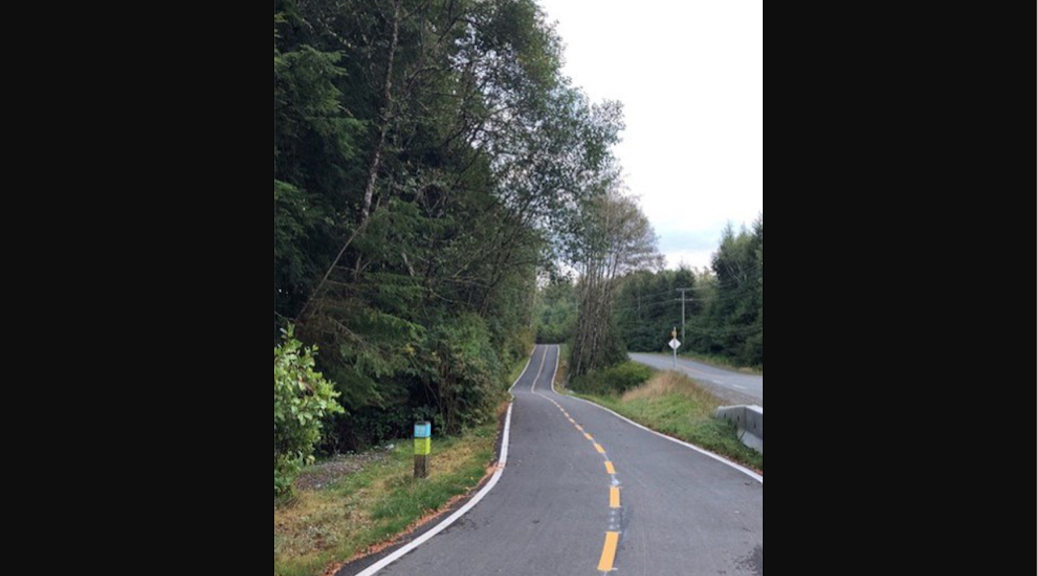
A new route from Sechelt to Lund: for humans, not cars

Editor’s note: It has been close to two years since Sue Bossley informed Cortes Currents that, as a result of the new water taxi service connecting Lund and Cortes Island, it was now possible for cyclists to pedal from Powell River to Lund, over Cortes and Quadra Islands to Campbell River, down to the Comox Ferry and back again. She called this the North Salish Cycle Route. (While Cortes Island is no longer listed as a regular destination, Access Point Marine Transportation does offer charter services. QXMC’s water taxi, Goat 1, has been sequestered to support the Klahoose Wilderness Resort from May until mid October, but is also available for charter in the off-season.) The story that follows takes this idea a step further, with a proposal to install cycling infrastructure on the route south from Lund.

Originally published on qathet Living

For the past few years, Sunshine Coast Tourism has been working on a plan to connect Sechelt to Lund with a safe, efficient route for cyclists, pedestrians, people using mobility scooters, and other folks choosing active transportation. It’s for commuters, tourists, and anyone who wants to enjoy the coast outside of a vehicle. 

In January, GJD Planning released the project’s second report. It breaks down the coast into 20 segments, and proposes infrastructure for each one. It also proposes which segments should get top priority. And, it notes that this will cost about $4 million per kilometre. 

Continue reading A new route from Sechelt to Lund: for humans, not cars

Eyes turn to B.C. as U.S. pauses approval of LNG projects

Editor’s note: According to Natural Resources Canada, “There are eight liquefied natural gas (LNG) export projects in various stages of development across Canada.” At one point there were 20 proposals in BC alone. One of them was on the old mill site in Campbell River. The most recent post Cortes Currents could find on the web was a Jan 21, 2019 article in the Campbell River Mirror which states a Calgary-based company, Rockyview Resources Inc, purchased the property in May 2016. “Rockyview is an oil and gas exploration firm that aims to build a liquefied natural gas (LNG) export facility at the site, a project dubbed Discovery LNG.”  The company’s website is no longer operational and Rockyview Resources Inc was ‘struck off the registry’ of Alberta Corporations on Nov 2, 2017. Discovery LNG is not on Canada’s list of LNG ‘Projects proposed and under construction,’ but it is listed as one of Campbell River’s top 10 municipal taxpayers for 2022 (albeit under a different owner).

By Matteo Cimellaro, Canada’s National Observer, Local Journalism Initiative Reporter

Calls from climate advocates to follow the lead of the United States and pause Canadian liquified natural gas projects face a serious challenge: a promise of economic reconciliation tied to capital and liquified natural gas (LNG) development.

Biden’s move to pause LNG approvals until after the November elections was celebrated by the climate movement in the U.S. and at home. But coastal First Nations leading LNG projects say the facilities will boost their communities’ prosperity. With industry partners, Haisla Nation is developing Cedar LNG and Ksi Lisims is proposed by the Nisga’a.

Continue reading Eyes turn to B.C. as U.S. pauses approval of LNG projects

SRD Receives Go Ahead To Establish a Regional Housing Service 

The Strathcona Regional District (SRD) received the go-ahead to establish a regional housing service and authorize loans of up to $10 million on an ‘as needed’ basis. While the SRD can raise funding for projects through property taxes, this money must be repaid once the projects start receiving rents.  

This matter was brought before the board at their January 24, 2024 meeting. 

Continue reading SRD Receives Go Ahead To Establish a Regional Housing Service