


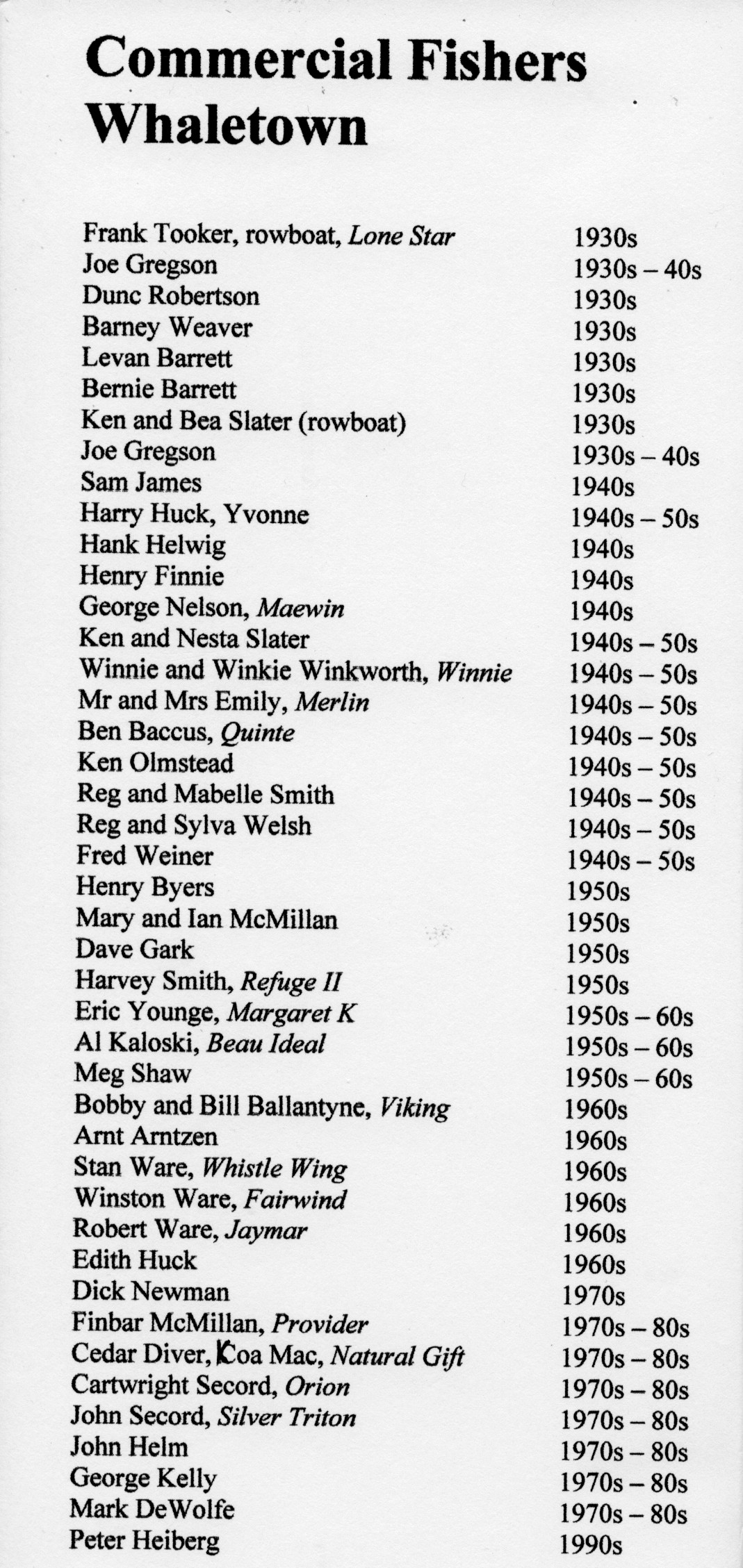
A great many fisherfolk once worked out of Whaletown. The Cortes Island Museum’s list goes back to the 1930s, at which point there were 7 men and a woman. Three of them used rowboats.
“There used to be a huge fleet rafted out, both six and seven abreast all along both sides of the dock, in Whaletown. In the last 10 years or so, there’s only been three or four boats in there, fishing. The main one that I know of in the last little while is the ‘C-Fin,’ but he goes outside of the Vancouver Island area and fishes tuna. When he comes back he doesn’t sell it to a fisheries, he sells it from the dock, and the same with his prawns. So he’s not using a middle man to sell his products, which I suppose is one of the few ways you could make a little bit of money now,“ said Lynne Jordan, former President of the Cortes Island Museum, in the latest instalment of her history of Whaletown.
Early fisherfolk based in Whaletown
The first name on the list of commercial fisherfolk from Whaletown is Frank Tooker, who had a rowboat named ‘Lone Star’ in the 30’s.
Lynne Jordan: “Fishing was sort of secondary to the main Whaletown occupation of logging, but there were a lot of fishermen that came up from the Lower Mainland and Victoria to base themselves out of Whaletown because the fishing was good in the Desolation Sound area, particularly between Cortes and Quadra Islands.”
“There was a fish scow at the dock, originally run by Mr Petrie, who owned the store. Then it was run by Meg Shaw, who was a member of the Robertson family. She got out of that around the late 40’s, and early 50’s. The scow sat on the beach behind and across from where the Whaletown dock is now.”
“In 1957, after Gary Bergman bought the store, he built a new scow and then dragged the building keeping the fish onto the new scow and docked it at the Whaletown dock.”
“Scows that were in inlets or small bays often had a small supply of things that the fishermen might need, but Whaletown had the store right there. Gary kept two sets of books, one for the fish and one for the store.“
“ Ben Baccus was usually one of the first fishermen that arrived from away, as they were referred to (people who lived in Vancouver or Victoria, etc). He usually arrived at the same time that the swallows arrived to nest in the shed on the Whaletown wharf. Before leaving Vancouver, Ben would buy some loaves of day old sliced bread from Woodwards and he spent his first few weeks hanging up the slices of bread to dry. Gary Bergman remembered that he seldom bought anything at his Whaletown store and though his boat ‘Quinte’ seldom left the dock. He did fish now and then. Ben was quite deaf, and although he did have a hearing aid, he seldom had it turned on because he was conserving batteries and money.”
“One of the few days he actually went fishing, he was just outside Whaletown Bay, near the marker and he kinda lucked into a huge school of Coho, but most of the other fishermen who’d gone out earlier that day were already over on the Quadra side fishing, and eventually he got word to the Cortes fishermen on the other side without letting other fishermen know that he was into a big school. They managed to come over and get into the school too. That was Gary Bergman’s biggest day ever on the scow. He had to have the packer come back a second time to take his load to Carlyle Fisheries.”


“There was another very narrow fish boat that was so small the owner’s legs and feet hung out the cabin door when he slept. The boat was jokingly referred to as the ‘West Coast Troller’ — trolling with his legs.”
“The ones that were using the Whaletown scow would bring their fish in. Gary Bergman would weigh them, ice them, pack them into boxes, and pay them cash. Carlyle Fisheries gave him cash and at any one time he had up to $10,000 in cash for paying fishermen. He also was responsible for keeping track of their unemployment insurance.”
“Carlyle Fisheries set the different prices for different species.”
“In the early days also, there was another fisherman from away, Art Arntzen also arrived in a small boat. Art was a little man, bent over and scowling. When he came into the dock with his arthritic hands, he’d get out his guitar and sing for everyone. His son Lloyd, brought his family up when they were just kids and they’d pitch their tents down by the government wharf in Gorge Harbour, and then put on concerts for everyone.”
“Another first comer in the 1940s was Doug Morton. He came to Whaletown with a Secretary of the Fisherman’s Union, his wife Jenny, and set up a Whaletown local with Harry Huck as President and Ken Slater as secretary. The Mortons stayed on in Whaletown and later started the Hacienda Marina when they bought some of Charlie Allen’s Bute Ranch in Gorge Harbour. There were a number of subsequent owners and one of them renamed the Hacienda Marina the ‘Gorge Harbour Marina,’ so you can tell where that property is.”


The Post WWII era
“A number of early fishermen were rowboat fishermen using hand lines, and then eventually, in I guess 1949 or the early 50’s, outboards came into use.”
“There were a couple of gals that fished. Meg Shaw and Edith Huck fished in little boats. Meg had poles on her boat that stretched out from the center of the row boat so she could handle them while she was rowing or using the engine. She had a hand gurdy as well, but Edith fished with a rod and reel. They brought in good fish.”
“During the war there was a big fishery for Dogfish, in particular for their livers for oil used for lubricating machinery. Teenagers could go out and earn good bucks, just fishing for the livers and then turn them into the scows and get paid cash.”
“The Calwell family lived just south of the entrance to Von Donop Inlet. Cliff Calwell trolled in the 1950s, usually at the north end of Cortes and outside Von Donop Inlet. He was catching big Spring Salmon. Occasionally Cliff had his hooks straightened out by really big ones that got away.”
“A large contingency came up from places like Vancouver after they were retired and would fish because that was something they enjoyed doing. There was a camaraderie with everybody at the dock, plus they were making a little bit of money at the same time.
“One or two of them bought houses around Whaletown and Gorge Harbour.”
“There was one fisherman that brought his float house into Whaletown every year and fished from that. He was one of the few that was fishing ground fish. So he had a live tank for his cod and when he brought them over to the scow, he would cut the heads off and gut them and just dump it overboard. Minks and otters learned very quickly that there was food to be had around the scow. They became regular visitors.”
“The Ware brothers were just starting out and didn’t know what species they were catching, and they would just put them all on the dock or the scow edge and tell Gary, “You call, I don’t know what they are!” were sometimes catching fish that were not legal. Gary protected them for a while, but he trained them finally, so that they would know what fish they were catching.”
“Locals like Harry Huck, Edith’s husband, was one of the main fishermen. Reg and Sylva Welsh fished the ‘Sylva Jane,’ which was built by Ken Slater in his boat works, which used to be between the post office and the library. There used to be a little bay there.”
“As a teenager, Bill Valentine had handline fishing from off of Camp Island, which is now the Subtle Islands.”
He and his wife Bobby (nee Corneille) later took kids out fishing sometimes for a few days on their boat, and so everybody in the Whaletown area knew them as Uncle Bill and Aunt Bobby.
“They fished well into retirement ages and eventually turned their boat into a yacht.”
““Bobby’s mother, Sarah Corneille, ran a lodge in Gorge Harbour. Bobby’s sister, Mabelle had been trained to service the engine on the boat that they used for bringing in customers to the lodge. She went out fishing with her husband and she was the engineer as well as a deckhand. They fished for quite a few years as well.”
“Often the woods would be closed in the summertime because of fire hazards, so there were a number of loggers that fished for a few months each year.”
“Of course those were the days when you could fish from April to early November. Today, it’s a matter of hours if at all, because the fisheries are trying to rebuild stocks.”


Old Salmon Runs
“Speaking of stocks, there are a number of creeks in the Whaletown, Coulter Bay and Gorge Harbour that had fairly good salmon runs for the size of them.”
“The new culvert they’ve built under the road at Hell’s corner in Whaletown, where the road makes a zigzag, used to have a really good salmon run back in the fifties. Brig Weiler when she was a teenager and her friend, Sheril Mathews, used to clean up that creek every year before the salmon runs. So I guess it’d be in the spring.”
“There was another little creek between Milstead Road and Carrington Bay Road that comes down behind the properties along there. That creek has become the water supplier for a number of houses in that area. The water is pumped up to a couple of big tanks up on top of a hill overlooking Whaletown bay, and it does run dry in the summers now. So that run doesn’t happen.”
“The creek in Coulter Bay, that the Tooker family built alongside of, used to have a small salmon run as well, and hasn’t had for quite a number of years that anybody’s noticed.”
“The main run in Gorge Harbour comes into Hansen Creek. You could walk across it without touching water because there were so many salmon, like Basil Creek in Squirrel Cove used to be.”
“Across on the other side of the bay where Christian Gronau and Aileen Douglas used to live, there’s a marsh that drains out of Anvil Lake and then a creek through the marsh into Gorge Harbour. Many years ago it was damned up by beaver who created that swamp area. The salmon couldn’t get above the dam, so they would spawn below the dam. Over the years it dwindled considerably because high tide comes up to that dam and I think the gravel also was fairly large there. Chum prefer a smaller gravel than what’s there, but they still came in.”
“Von Donop Creek had salmon too, but not many. When Andy and Bruce Ellingsen were young, they said only about a dozen salmon would come up the creek that’s down at the bottom corner of Von Donop Inlet, but I don’t know if anything comes in there now.”
“That was all part of the fishing.”
“There were fishermen from Quadra that were fishing on the Quadra side between Cortes and Quadra. Often, particularly if the weather was rough or the tides and currents were too much for them to go around Cape Mudge to drop their fish off in Campbell River, they would come over to the Whaletown scow for Gary to buy their fish.”
“There were a couple of fishermen from Quadra that used to go up Bute Inlet. They’d catch the White Springs up there that were just huge. Gary recorded a number of them that were a hundred pounds or a little over.”
“When it’s that big and white, the Carlyle Fisheries would cut the fish into smaller pieces, smoke them and sell them as smoked cod to New Yorkers who paid a big price for them. They didn’t know the difference between a white salmon and a cod.”
“The net marked salmon would go for canning. The ones that were not marked, the ones that trollers caught, were prime fish and got the biggest bucks. They went for the fresh market.”


Frank Tooker standing behind the cabin of a fish boat – Photo courtesy Cortes Island Museum

Velma Bergman, weighing salmon in the fish scow at the Whaletown dock – Photo courtesy Cortes Island Museum
Stories from the 1970s
“In 1970, there was a big 42 foot American seine boat that ran aground on Shark Spit. As it ran aground, the keel broke. So the fishermen abandoned it and flew back home to the States. They were returning home from Alaska fishing.”
“Some locals got permission from authorities to salvage the boat and everything on it. Frank Hayes was living in Whaletown, Jack Perry was from Smelt Bay and Jay Martin also participated. They gathered empty barrels and were successful in floating the boat off the Spit and then towing it around the corner into Whaletown Bay and beaching it there where they could take it apart and salvage what they could.”
“The ‘Cortes Grapevine’ was a column that was published on the Island and in North Island newspapers during 1970. In November, they reported that Harry Huck had returned home for the winter months. He’d been a fisherman, but in 1970 he was on fish patrol for the Department of Fisheries. He returned to his Whaletown home after being aboard a fish packer for most of the summer and then spending the last few weeks tagging salmon for the Department of Fisheries.”
“The following year, in September 1971, Harry Hunter disappeared. They never found his body when his gillnetter ‘Marcia Mel’ sank. Though he lived in Nanaimo, he had previously lived on Cortes and was still based out of Whaletown.”
“There actually were a lot of fish boats that sank, but regulations and inspections of fish boats have increased over the years, so that less and less of that is happening now.”
“In 1971, Jim Hansen went hunting on Marina Island, which was then called Mary Island. He came home with a fish instead of a deer. No, he didn’t shoot the fish! Evidently, his story went that an eagle dropped the rather large fish on him, but all his fisherman friends thought that it sounded like a fish story.”


Lynne’s late husband, Joe Jordan, started fishing in the 1970s.
Lynne Jordan: “Joe fished with Harvey Smith sometimes out of Whaletown when he first started, but then out of Manson’s. They fished the Johnstone Strait in the earlier years, then went further north to Smiths and Rivers inlets. Also fishing with them were the Tooker boys.”
“Joe fished up until his mid seventies. One of the last times he was out fishing wasn’t even a 24 hour opening scheduled, but then they did extend it to 40 hours or so. He was in Johnstone Straits and there was a whole bunch of boats out fishing. Sometime after dark, he looked around and there was just him and one elderly Japanese fisherman. All the young fellas had gone in to shore or dock or anchored somewhere for the night. Joe was good at taking 20 minute naps when his net was out, standing up by his drum. You just fished that way, and took advantage of every minute you could cuz it was such a short season. The young fellas had gone in to shore, or dock , or anchored somewhere for the night and didn’t fish through the night. They were back out in the morning first thing. That was something Joe couldn’t understand, ‘When you had a fish opening, you fished, okay.’”
“Back in the fifties, fishing license was a dollar. Nowadays you pay thousands of dollars for a fishing license, and plus you have to buy a boat and keep it up. So it’s really difficult nowadays to make money as a fisherman, unless you’re on a great big boat that’s doing the seining and bringing in big bucks, but even they’re becoming fewer.”
“With the market being down, the supply being down, the numbers of salmon aren’t there. The numbers of herring aren’t there. It goes all the way down the food chain. So it’ll be awhile before fishing ever comes back, I think.”
Top photo credit: The Whaletown fishing fleet in 1948 – courtesy Cortes Island Museum
Sign-up for Cortes Currents email-out:
To receive an emailed catalogue of articles on Cortes Currents, send a (blank) email to subscribe to your desired frequency:
- Daily, (articles posted during the last 24 hours) – [email protected]
- Weekly Digest cortescurrents – [email protected]