

In this morning’s interview we hear from Sara Stewart of Wildflower Produce and Cidery, near the southern tip of Cortes Island.
Sara Stewart: “I’m not a religious person, but when you depend on the natural world you become deeply ingrained in it. I used to think I was building connections with the natural world when I lit a fire on Imbolc (the Ancient Celtic beginning of Spring) and celebrated Soma. I now find that rituals or ceremonies can disconnect you from nature. So I try to cultivate the spirituality of a squirrel. I don’t see wildlife celebrating Imbolc—you just notice what’s happening in your body and respond accordingly.”
Cortes Currents: Where do you come from and what inspired you to get into agriculture?
Sara Stewart: “I grew up in a subdivision in Southern Ontario, so I didn’t have farming in my family. I gardened for a long time and I was vegan because, once you learn about the food industry, it’s pretty appalling. I worked for nonprofits before farming because I’ve tried to align my work with my values, not with the goal of a higher income. Nonprofits aren’t profitable, and farming is very, very difficult to make ends meet financially and to turn a profit. The most I’ve made farming for myself is about $5 an hour, so it’s definitely a challenging lifestyle.”

“I first got into it as a farm hand when I was 33, but I’m a little bossy, so I became the boss the next year. I became the field manager. I’m pretty good with spreadsheets. I have a very logical mind, and I often say that farming is like playing Sudoku in your mind, but with plants.”

“So if I plant this here, then that has to go there; if I time it like this, this has to go over here. So it’s a lot of planning in the winter. So I do spreadsheets showing where everything is. I have a calendar for when I seed things, when I transplant them, and when I harvest them, and that’s very left-brain.”
“Then in the summertime it’s very right-brained and creative to apply that plan to what’s actually happening, because it rarely lines up with what I intend.”
“This is my 11th season being a market gardener, and season number seven on Cortes. That part has become a lot more established and less challenging. The first year here was a carpet of weeds and very poor soil quality. I test every year. It’s been nice watching the nitrogen and organic matter increase.”

“I grow about $50,000 worth of produce a year, mostly on my own. I do have volunteers who contribute about 15 hours a week in the summer, which is nice. I sell mostly at my farm stand here and at the Cortes Natural Food Co‑op as well.”
Cortes Currents: Tell me about coming to Cortes. Why did you come here and when?
Sara Stewart: “I was working on farms for a few years as a farm manager and then decided I wanted to lease land for myself. I toured the Gulf Islands and down in Saanich. When I finished, someone recommended Cortes. I came here on a visit and I crashed a funeral and realized there were people my age here; elsewhere it had been mostly seniors. Someone told me about Reef Point Farm and that this might be a place to lease land. I contacted them, they were paying caretakers, and I had the idea of paying them to farm here. That was in 2019.”

“I started my first year farming here in 2020 with the goal of being a market gardener—growing vegetables. It just kept growing from there. The next year I got chickens, the year after that I got sheep, and in 2022 I did the business plan for the cidery.”
Cortes Currents: How many years in total have you been making cider?
Sara Stewart: “This is number three.”
Cortes Currents: What connection are ravens to your starting a cidery?
Sara Stewart: “There’s an orchard here that was planted in the late seventies, and hadn’t been looked after. Ravens have come in the summertime for decades, with free access to 10,000–20,000 pounds of fruit. When I arrived to market a garden, there were four raven pairs established here.”
“Then one day in August, when the plums were ready, 30 ravens showed up. Many were babies and full of sugar from the fruit they’d eaten. They were destructive. They destroyed equipment, tore up irrigation, and ripped the row covers that protect from pests and help with temperature control. They’d follow me around. If I set something down and walked away, they’d flip it over. I’d plant a row of lettuce, come back, and they’d have pulled it all out—not even eaten it, just destroyed it.”
“Starting the cidery was a way to deal with the pest: remove the food, and you reduce their visits because they’re here for the fruit. At first I tried selling fruit, but the orchard hadn’t been tended for years and there were pest and fungal issues. Still, that doesn’t matter when you’re making juice.”

“The fruit quality wasn’t great, and there wasn’t a huge market for it. There are only so many people on this island who want to buy apples, so I sold the good quality fruit, but it was maybe 5% of what I could sell. I looked into selling fruit off‑island. For about every thousand pounds, I’d make about $80, excluding my time. It didn’t make sense to sell fruit off‑island.”
“I got a grant to do a business plan. We looked at all the options, and cider made the most sense.”
Cortes Currents: I have this image in my head of all the ravens coming. How long does it take to harvest the orchard, and how far ahead of the ravens are you?
Sara Stewart: “That’s a tricky one. They love cherries. Usually the songbirds come first and the ravens come second. So I start picking when I see the songbirds on the cherries.”
“It’s definitely a game of picking slightly early so I don’t end up with nothing. I use scare tactics like tin tape and pie plates, but ravens are incredibly smart and desensitize quickly. It’s a game for them and often devastating for me. Being 43 and losing to birds isn’t a life goal, but here we are.”
“The apples come in succession—usually at least one or two days of harvesting a week. Once you get going, it doesn’t take long to work a row of trees or go to someone’s property. I don’t use ladders. We shake everything down. It doesn’t matter if it’s bruised; if anything opens, it goes to wildlife. We usually toss it into the bushes. Shaking them down is far faster. There are very old apple trees at the Gorge that are over a hundred years old, so shaking them down is basically the only option and it’s more time‑efficient.”
Cortes Currents: Tell me about your business. How’s it working out and what varieties of cider do you make?
Sara Stewart: “It’s a unique model for a small island. You can’t compare it to operations in Victoria or Nanaimo, which can handle much larger volumes and have access to more stores and restaurants.”

“I did 500 litres that first year, just to practice. Then 6,200 litres the second (about 8,000 bottles), and this year I did around 4,000 litres—slightly less. I never set out to own a cidery or be a cider maker; it happened because it makes sense. I use permaculture principles to build the business—utilizing what’s around me. So I don’t chase exotic flavours like pineapple or passion fruit.”
“This year, for example, a volunteer picked huckleberries, so I’m making a huckleberry cider. A friend had a lot of elderberries, so I’m making an elderberry cider. I also had issues with the walk‑in cooler breaking down, so I’m doing experimental blends like basil, hot pepper, and cantaloupe, alongside apple and pear and more traditional varieties. I’ve been getting more recognition and I’ve started doing the Comox Farmer’s Market in the off season, which has helped spread the word.”
Cortes Currents: Do you export to any cities?
Sara Stewart: “I do. I’m delivering tomorrow to a couple of natural‑wine stores and a few restaurants. I have someone helping me sell in Vancouver; he runs a natural‑wine importing business. His aunt lives on the island. He’s been very kind, not even taking a commission, and he’s helping me.”

Cortes Currents: How many trees do you hve?
Sara Stewart: “There are about 500 fruit trees—roughly half apples, plus plum, pear, and cherry. I don’t make a cherry cider yet because pitting the cherries is too time‑consuming.”
“I also buy fruit from around the island and from Quadra Island. A main goal is to support other food producers. For example, I bought about 5,000 pounds of Henry’s fruit from Blue Jay Farm last year. There’s another older farmer on Quadra, and I helped him get his farm status again by buying his apples. It’s nice to support other producers this way.”
Cortes Currents: Do you pick the fruit yourself, or do you hire people?
Sara Stewart: “I do a lot of picking myself, but I have bad scoliosis, so I delegate to volunteers and others who are willing to pick. I’ve advertised for huckleberries on the Tideline; someone with a ton on their street was making about $30 an hour harvesting for me. I have WWoof volunteers (Worldwide Opportunities on Organic Farms) and Workaway participants.”
“It’s nice to use food that would otherwise be wasted, and I don’t waste it because it often goes to wildlife. I never harvest all of it when it’s wild harvest. I try to follow the rule of thirds: a third for me, a third for wildlife, and a third returned as seeds.”

“The way I make cider is quite different. Most commercial ciders press the juice or purchase juice, then kill everything with sulfites and add a yeast to make it predictable and consistent. I don’t do that. I just press juice, put it in a tank, and let the natural yeast ferment.”
“I’ve named the yeast; I call it Dusty. I try to see it as an individual because, even though there are hundreds of yeast types, one becomes dominant. It lives in the cidery—in the boxes and walls. Treating it as an individual helps me meet its needs. It surprised me how quickly I learned to manage cider; my first batch was after starting the business.”
“It turned out really well. It became almost like livestock to me, with each batch having its own enclosure and life history. They need to be warm enough, have enough oxygen, and have enough food.”

“I know how to keep things alive. I have sheep, chickens, a dog, and a feral cat. I’ve worked in wildlife rehab, where injured and orphaned animals would come in. That trained me to treat things as individuals and meet their needs.”
“The first year was a bit more scheduled; this year I’ve learned to act more intuitively. That comes from farming and staying connected to natural things. Whenever you try to impose a schedule or ceremony, it can become ego‑driven and distance you from nature.”
Cortes Currents: How long does the cider sit in tanks?
Sara Stewart: “It depends on the style. Last year I did a pét‑nat style—bottling before it’s finished and letting it age in the bottles. I’m not doing that this year. All of these were pressed in September and October, and I’ll bottle them in February and March. It allows the flavors to amalgamate a bit more and undergo an aging process I don’t fully understand, but it’s a chemical process. Any particulates settle. I don’t filter or pasteurize; it’s a cold clarification. I try to get it down to a couple of degrees so the sediment sinks to the bottom and doesn’t end up in the bottle.”
Cortes Curents: Are you’re ciders alcoholic?
Sara Stewart: “They’re all alcoholic.”
“It’s actually very hard to make non‑alcoholic. For example, with juice, it’s less stable. Alcohol acts as a preservative. If I tried to do something without alcohol, I’d need a lot more intervention and additives, which isn’t my style. I prefer to rely on what happens naturally.”
“This is how cider would have been made in the 1500–1600s, except I have stainless steel tanks and much better hygiene than they did back then.”
Cortes Currents: What percentage is it?
Sara Stewart: “They’re all under seven. Usually about six, six and a half, seven is what I did last year. The sugar content of the apples is what dictates the alcohol content.”

Cortes Currents: She utilized two sizes of vessels for her cider: large primary tanks and 23-liter carboys that held highly concentrated fruit infusions to punch up the flavor profiles of her main blends.
Sara Stewart: “These are all of my small‑batch experiments, which I call the ‘weirdos.’ They don’t always work out. They’re very concentrated and in 23‑liter carboys, so, for example, the huckleberry infusion is very strong and the melon infusion is very strong.”
“We’re going to start doing blending trials soon to see what percentage of the concentrate will mix with the apple juice. I have about 1,000 liters of straight apple juice, but it isn’t the best quality—it’s bland compare to the Blue Jay apples. Having a blander base helps these flavors come through.”

“Last year I did a carrot‑ginger infusion and thought it would be 10% carrot juice, but it ended up around 2%. The flavors are quite strong. We’ll run blending trials to mix the huckleberry, melon, elderberry, and quince to find the right blend. I’m also doing a lilac plum this year and exploring botanicals as well.”

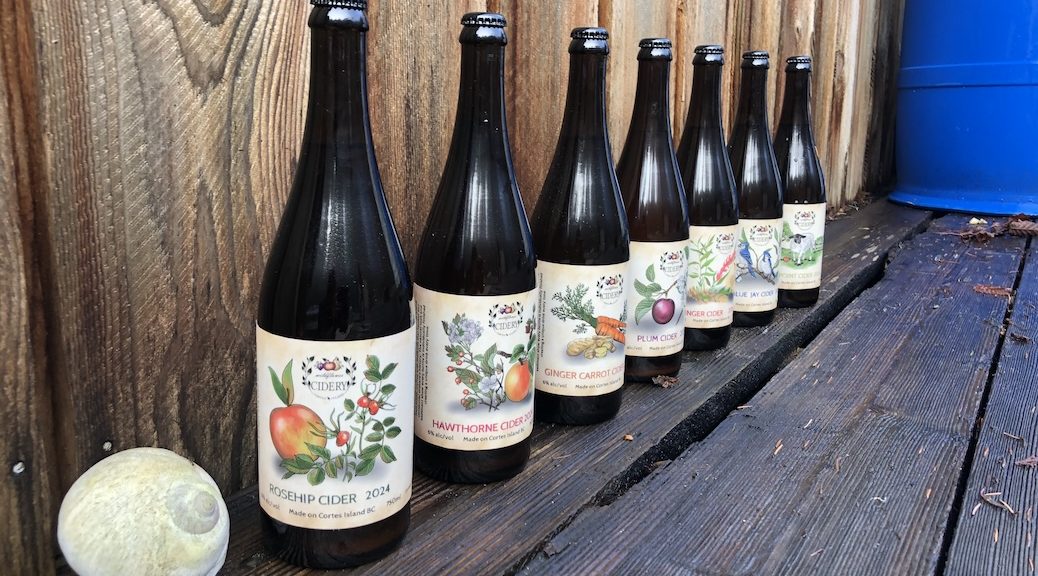
Cortes Currents: Sara brought out seven samples of her cider, each variety with a distinct flavour and label.
Sara Stewart: “Kim Marks did the artwork for all of my labels. She’s the tattoo artist on the island, and then Tamlyn Collingwood from Twig Root is better at computers than I am and she helped do the composition of the label.”
You can follow life at Wildflower Produce and Cidery through Sara’s Facebook and Instagram pages, where she posts photos of work on the farm, her sheep, cidery and important events.
Links of Interest:
- Sara Stewart Launches Wildflower Cidery on Cortes Island – Cidercraft Magazine
- Articles about, or mentioning, Sara Stewart
- Facebook – https://www.facebook.com/wildflowercidery
- instagram – https://www.instagram.com/wildflowercidery/
Undesignated photos by Roy L Hales
Sign-up for Cortes Currents email-out:
To receive an emailed catalogue of articles on Cortes Currents, send a (blank) email to subscribe to your desired frequency:
- Daily, (articles posted during the last 24 hours) – cortescurrents-daily+subscribe@cortes.groups.io
- Weekly Digest cortescurrents – cortescurrents-weekly+subscribe@cortes.groups.io