
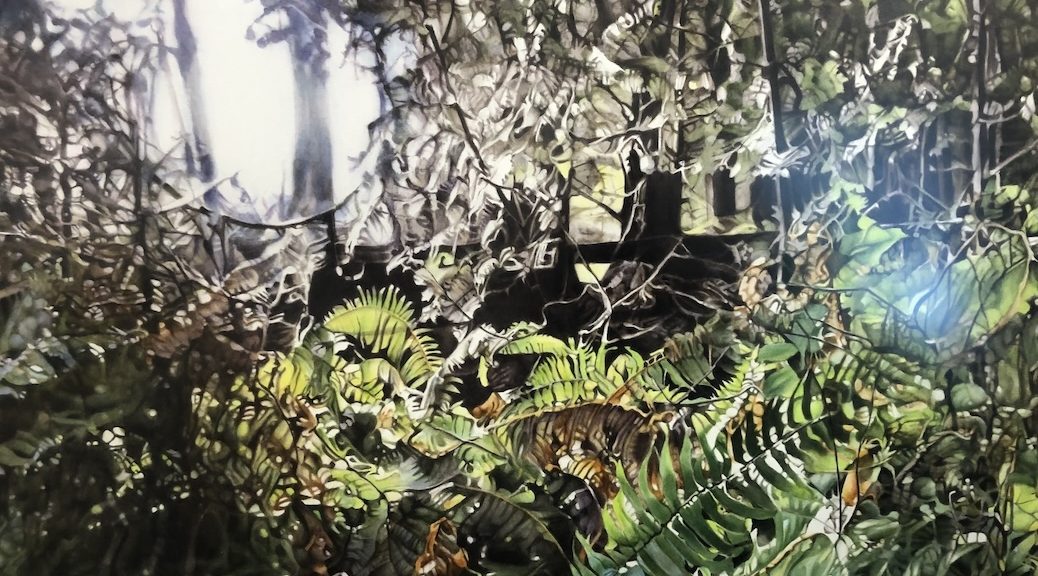

From August 29 to September 14, the Old Schoolhouse Art Gallery will host ‘How Do You Like the Underworld?—Kristen Scofield-Sweet’s final large-scale exhibition.
“This is my retirement party swan song on the wall,” she began. “This is a body of work that’s complete. One of the remarkable things about that is the artist doesn’t usually get to see their work all hung together, obviously, unless they have a show. You’re used to seeing a piece over the couch with the pillows or the throw at the back. To actually see them having a conversation with each other is really special.”
“Every picture tells a story, so you can get all tangled up with how it got painted and why, how I work and yada, yada. In an exhibition like this, the work gets to speak for itself, and that’s really profound.”

Cortes Currents: How did you come up with the title?
Kristen Scofield-Sweet: “It’s just an image from walking down the road in my neighborhood, looking for something significant, clicking along, taking pictures. When I got back home and looked at them, it was like, ‘whoa!’ The notion ‘How do you like the underworld?’ just popped into my head, and so there it is.”
Cortes Currents: I have to ask, how do you like the Underworld?
Kristen Scofield-Sweet: “I think we live there.”


Cortes Currents: What is the Underworld?
Kristen Scofield-Sweet: “You can come at it from the very ancient Siberian folk tale about the giant fish that turns the world over. Scientists actually attribute that story to the shifting of the poles, that it would have been an echo of the experience of that. We’re supposed to do it again. So at the moment, we’re already living in the underworld because the poles traded places.”
“I have spent decades with a shamanic practice. It is, after all, the oldest form of spirit relationship. It is not particular to any one group of people. Everybody comes from that background if you go back far enough.
“Way back in the 1980s I became quite attracted, and I made my first drums in maybe ’83 or ’84. Ever since then, the journey of making drums is enough to take you to the underworld. Trust me, there’s so much in that process.”
“People quite often say, well, who gave you permission?
“There isn’t a culture on the planet, no exception, that doesn’t have something stretchy over something stiff that makes a sound, no matter where you go. Drums are just like a flute, which comes from an arrow, or a guitar, which comes from a ladle. A drum comes from a bowl. You can’t get more fundamental than an arrow, a ladle, and a bowl.”
“Our music comes from this very, very deep place, and we all share that in our genome—in our cellular blueprint.”
Cortes Currents: When most people hear the word ‘underworld,’ they think of death.
Kristen Scofield-Sweet: “Well, it’s not like it’s not going to happen. I think that’s another whole topic. I’ve been a practicing Buddhist for 30, 35 years, and that perspective on death is very profound and ordinary and easy.”


Cortes Currents: She pointed to three pictures on the wall.
Kristen Scofield-Sweet: “People think, ‘oh, they’re about death.’ It’s a dead bunny, a dead bird and a dead rat, but those are actually all quotes from Carl Jung, and he’s talking about dreams. I think the dream state is a very parallel state to the death state. I didn’t say the same thing, but they operate with a very parallel language.
“So regarding the notion that the underworld is somehow over there and unreachable and something that isn’t available—no, we’re in the underworld. We’re in and out all the time. I don’t think of the underworld as death. I think of it more as this world.”


Cortes Currents: When I asked her about continuing to paint smaller pieces, Kristen referred to the Oracle deck that she created in 1992.
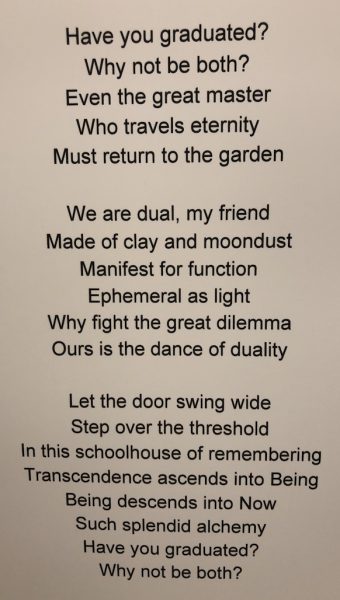
Kristen Scofield-Sweet: “You were taking some images of those double sets, a painting and a poem. It’s been quite a bizarre process. The poem is written by Anne Mortifee. I send her a question, which will be the title of both the poem and the painting. She doesn’t see the painting. She does not know what I’m doing. I don’t see what she’s writing. We don’t actually put them together until both the poem and the painting are finished.
“The only requirement is that she has to start and finish the poem with the question.
“So we are quite often just amazed at how they click together, because we didn’t do that—at least not as ordinary little humans.
“We’ve done 37. There are 47, so we have 10 to go. Those I will absolutely keep working on.”
Cortes Currents: Seven of the works in the current exhibition consist of a poem beside a painting. Kristen says there will be a total of 94 images for the Oracle deck.
Kristen Scofield-Sweet: “Every card has an image on each side. I am giving a talk next Friday, and one of the things I will talk about is how I like to create uncertainty in my work.”
“I like to create edges where I can’t do everything. I have to just do one thing. These cards are a really good example, because when I painted the first one, I sat down. I did it all without getting up. I remember hearing myself say, that’s it—and then I realized that’s it. You have to paint every card at one sitting, and there can only be one card. You can’t make four of them and then decide what you like. Many of them are not, to me, aesthetically attractive. They’re lumpy or muddy or confusing – but maybe it’s exactly the card you needed to draw, if you were working with the Oracle deck. It’s not up to me to make an artistic decision about that. You can only do it once. It creates a kind of an edge, and I really enjoy that in my work.”

Cortes Currents: What do you do with an Oracle deck?
Kristen Scofield-Sweet: “Well, in the first place, an oracle is not the same thing as a divination deck. An oracle doesn’t work from a specific question. What you do is sit holding the deck and think of a situation, not a question.
“Maybe you’re just sitting in a situation of, ‘I don’t know what to do,’ or ‘I don’t like what I’m doing. My job’s not working,’ or ‘Where I’m living is difficult. I don’t know what to do.’ You’re not trying to find an answer. You’re just sitting in that, and then you draw four cards. Each card has four pages.”
“Let’s say you began with card number three. This would describe your situation. The situation began by forgetting to ask for signs. Now you might go, ‘oh, I get that,’ or you might go, ‘I have no idea what that means’—and you work through this. The second card you draw is about the experience of your situation. The third card is about the change that is trying to find you, and the fourth card is the resolution—what to do. So you create a reading to view your situation with those four cards.”
Cortes Currents: But you wouldn’t call that divination?
Kristen Scofield-Sweet: “It is a divination, but it’s not like fortune-telling, like the Tarot. There’s nothing wrong with them—I’m perfectly fine with that—but they don’t work with a complex energy. They work with a question, and what happens with an oracle is that it will show you what the question is, not the other way around.”
“It’s not about me thinking I understand my situation, and now I’m trying to find a way out of it, or into it, or to fix it more. It’s saying, I have no idea how I got here. I don’t know what to do. The Oracle shows you what really is going on, and then eventually in the resolution, what to do about it.”


Kristin Schofield-Sweet is a former high school art teacher, an art educator from the Nova Scotia College of Art and Design, as well as a professional illustrator, drum maker, and one of Cortes Island’s better known artists.
You can read her post ‘How I became a drum maker’ on her website, journey oracle.com.
This interview opens and closes with the clip shamanic drum by adharca at freesound.org
Links of Interest:
- The Journey Oracle website
- Old Schoolhouse Art Gallery Facebook page
- Articles about, or mentioning, Kristen Schofield-Sweet
Poems by Ann Mortifee; All photos of Kristen’s artwork and exhibition taken by Roy L Hales.
Sign-up for Cortes Currents email-out:
To receive an emailed catalogue of articles on Cortes Currents, send a (blank) email to subscribe to your desired frequency:
- Daily, (articles posted during the last 24 hours) – [email protected]
- Weekly Digest cortescurrents – [email protected]