

Linnaea Farm’s First Plant and Skill Share was on Saturday, April 18. It may be the first on Cortes Island.
Tamara McPhail, who has been at Linnaea farm the past quarter century explained, ”I don’t know if there’s ever been a plant share before on Cortes.”
She asked a group of Cortes residents, standing close to us, if they had ever heard of a plant share on Cortes?
Pierre Belcourt, replied, ”Cloud sale?
Tamara: “A plant share, or plant swap?”
Pierre: “I don’t understand, appliance?”
Female bystander: “Swap, you swap.”
Pierre: “Oh, swap. You wanna exchange my washing machine for your cookstove?”
Cortes Currents: “Yeah, except with plants.”
Pierre replied, ‘No’ to having heard of another plant share on Cortes.
I’m not sure how long Pierre was pulling our legs, but that exchange provided the title for this article, ‘Possibly Cortes Island’s First Plant and Skill Share.’
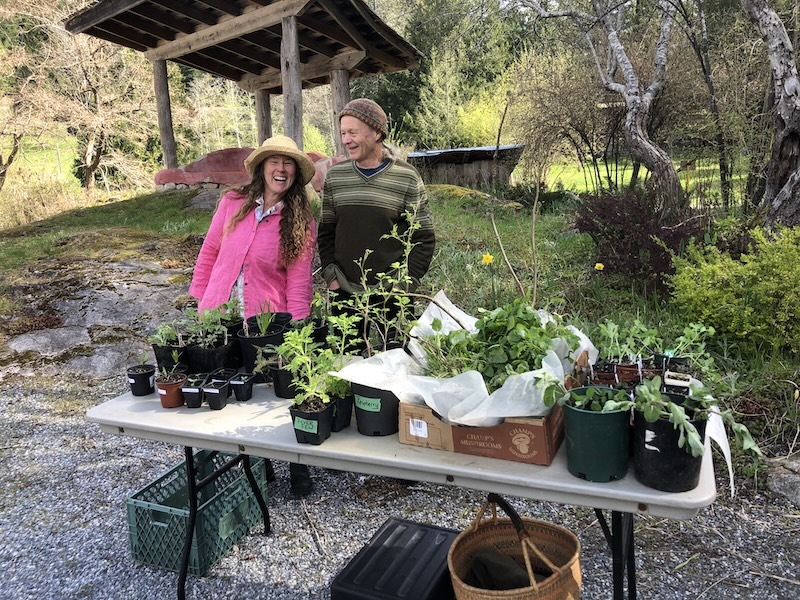
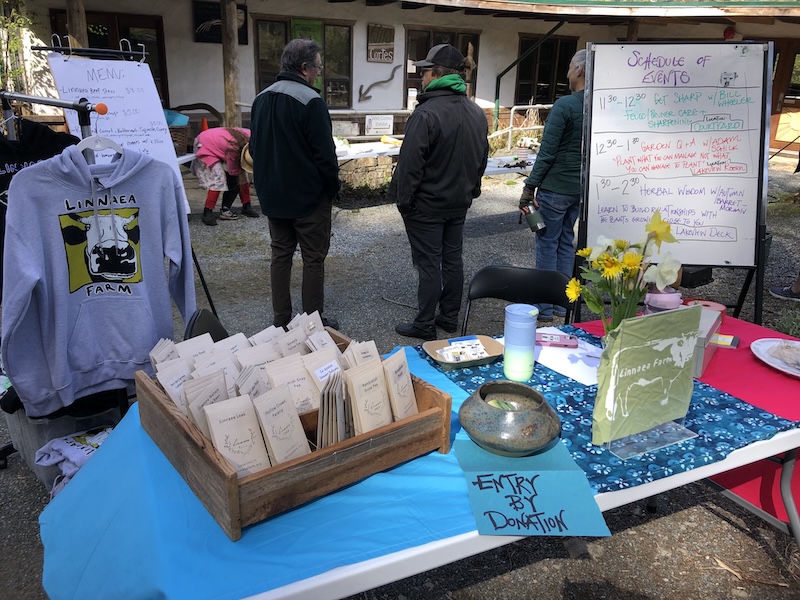
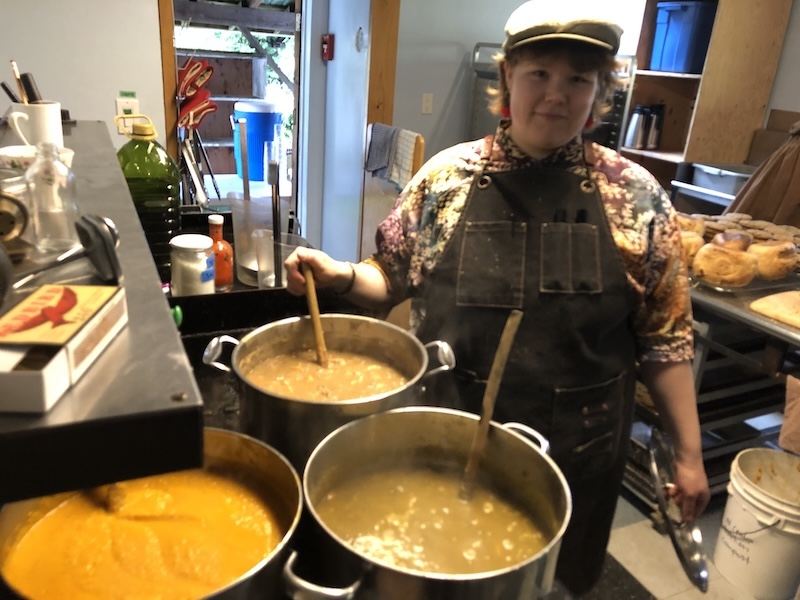
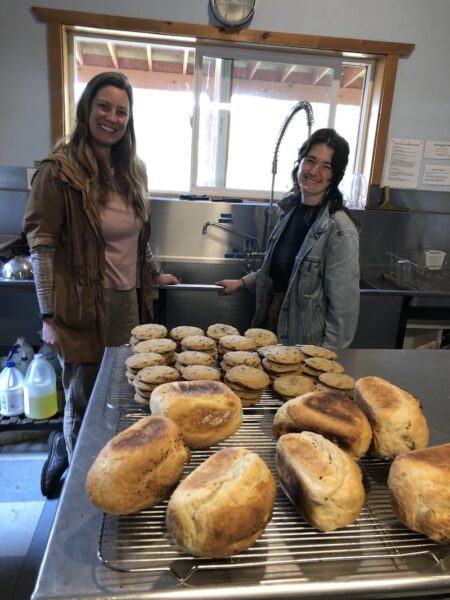
There were three workshops, tables full of plants and seeds and a choice of three menu dishes for anyone who wished to buy lunch.
Sharpening Tools
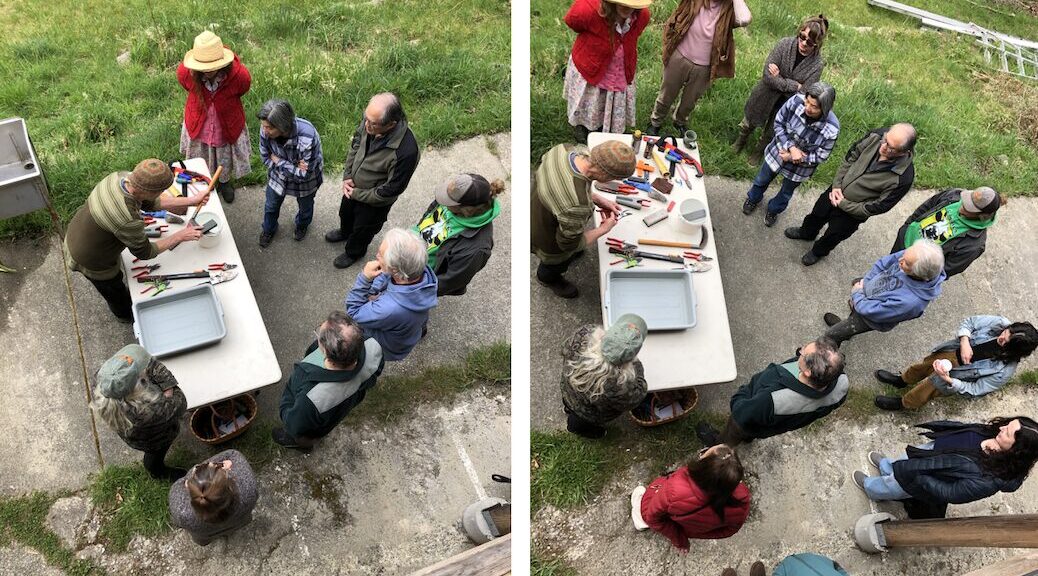
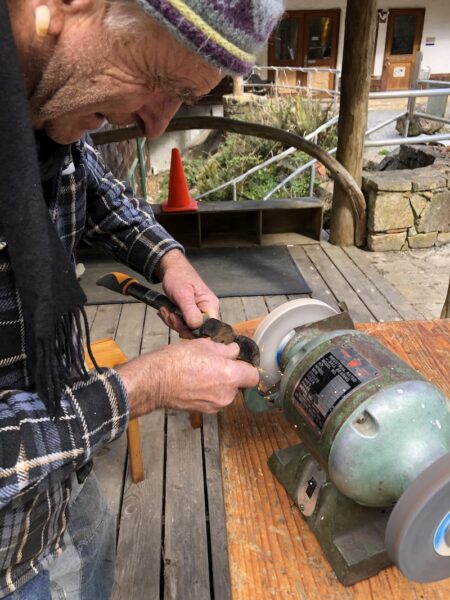
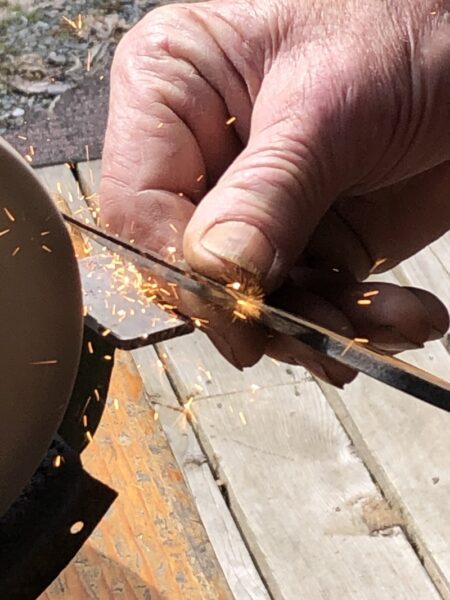
Pierre had a bench grinder set up to one side of the greeting area.
Cortes Currents: How long have you been sharpening tools?
Pierre: “Maybe 50 years or so. I was into boat building a long time ago.
Planer blades, hand planes, chisels: All those things work so much better when they’re sharp. Same thing with the kitchen tools. Everything works better when it’s sharp. Some people are afraid of sharp edges, they purposely have dull lives. I think it’s actually a mistake myself. You can harm yourself way more; You push so hard to cut something – so if it goes the wrong way …”
He let that suggestion remain unsaid.
Cortes Currents: Do you do much sharpening here on Cortes?
Pierre: “The year before last, just about every week at the Manson’s Hall and last year less and now it’s maybe once a month. There’s not enough people coming to Manson’s Hall on Fridays to make it worth it. So I think we’re gonna do it about once a month. Even in the summertime, in July and August, there’s all of these tourists that tend to just want to take pictures of somebody doing something.”
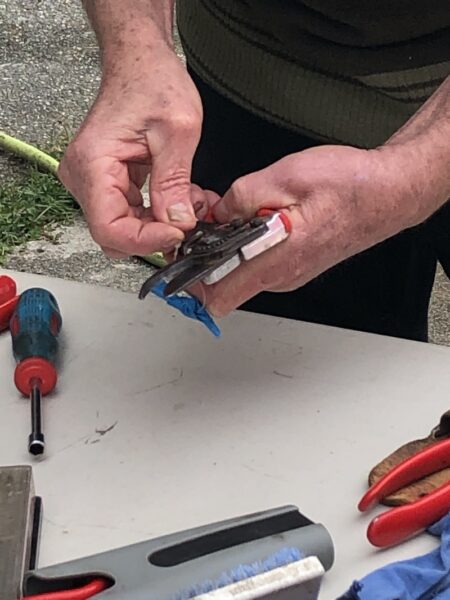
The first workshop was “Get Sharp with Bill Wheeler.” People brought their tools. He cleaned and sharpened them, while explaining how they could do this themselves. As the crowd kept growing and I didn’t want to interrupt everything to ask if they minded being recorded, I decided to interview someone about their experience.
Tamara: “ Yeah, it was totally worth it: having been an avid pruner and gardener for well over three decades and having never known how to take apart my Felco hand pruners. Bill showed us in slow detail how to take each piece apart, how to clean it, what to clean it with, and then how to put it back together after sharpening it. My tools are in better shape than they’ve ever been and now I know what to be doing on a yearly timeframe so that they stay in good shape.”
Q&A With Adam Schick
The next workshop was a Q and A in the Lakeview Room with Linnaea’s head gardener, Adam Schick. Much of this was advice about growing specific crops on Cortes, but there were also gleanings of wisdom for people with their own small plots.
Adam: “ What are your objectives? What are the objectives of your garden? Is it to make salsa? I want to try to eat year round. I just love basil and I wanna make all my pesto. What do you want to eat? Just because you can grow a whole bunch of things doesn’t mean you should, unless you want to eat all of those things too. So figuring out that stuff is really important, especially when you have a small garden.”
“In the market garden world everyone wants perfect stuff. It has to look perfect, it has to be perfect and that’s what the marketplace sort of demands. Anything less than perfect is not a valuable thing.”
“As a home gardener, you have that choice. You’re just trying to feed yourself and if it has a few holes in it, as long as it’s not affecting its ability to thrive, you just eat it. There’s even been some reports and studies that vegetables that are under slight attack actually build a few more antioxidants. They have immune systems too. A plant that’s under a mild attack actually develops in a way that’s a little bit more healthy than something that’s given perfect conditions, everything at once, and all the time.”
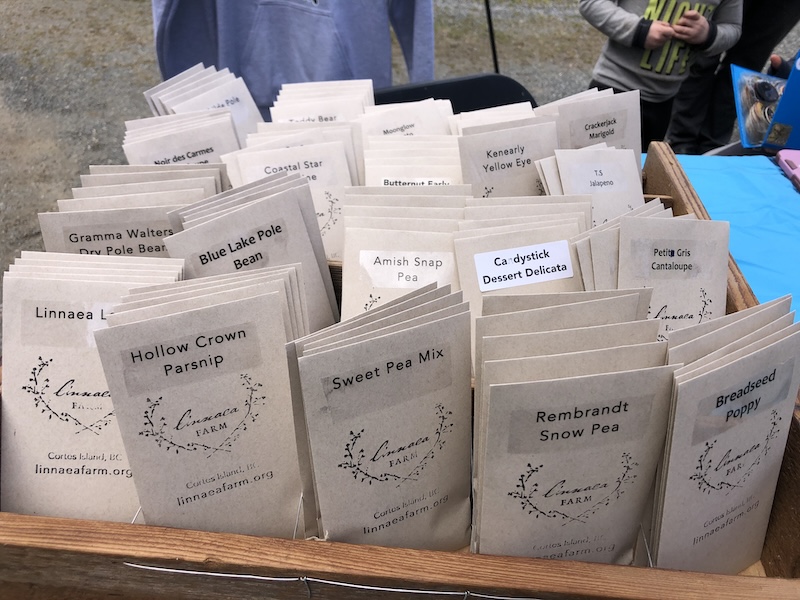
After years of being a market gardener, Adam now grows a little for his own needs and focuses on producing seeds.
Adam: We’ve all become really aware about food security and the importance of growing local and all that sort of stuff, but where is your seed coming from? Most of the seed is grown as a commodity crop, and the big food corps have found the places in the world and the climates that are best suited to and adapted to grow those seeds. Like most of the brassica (bok choy, broccoli, Brussel sprouts, cauliflower, cabbage, collard greens, choy sum, kale, kohlrabi, napa cabbage, rutabaga, turnips etc) are grown in four different places in the world. One of the places just over the border in the States. There’s these little zones where there’s like a hundred square kilometers and that’s all that they do in those are grow all the brassica. So it’s like the whole world of seed is also commodified and controlled and in the hands of very few people. That’s why growing your own seed and saving your own seed and having a local network of seed savers is so important.
“ When you’re dealing with a big seed company, they’re just really brokers. They’re buying those seeds from all those places, doing a germ test and then passing them on to you. The company saw everything’s good, but when you buy my seeds, they’re seeds that are growing right here. They’ve been locally adapted to the climate a little bit more than say the beans you’re getting from the Central Valley of California or somewhere in New Jersey or wherever all these seeds are. They’ve adapted to those regions, by buying local seeds from local seed producers, you’re getting seeds that’s grown right here.”
Herbal Wisdom
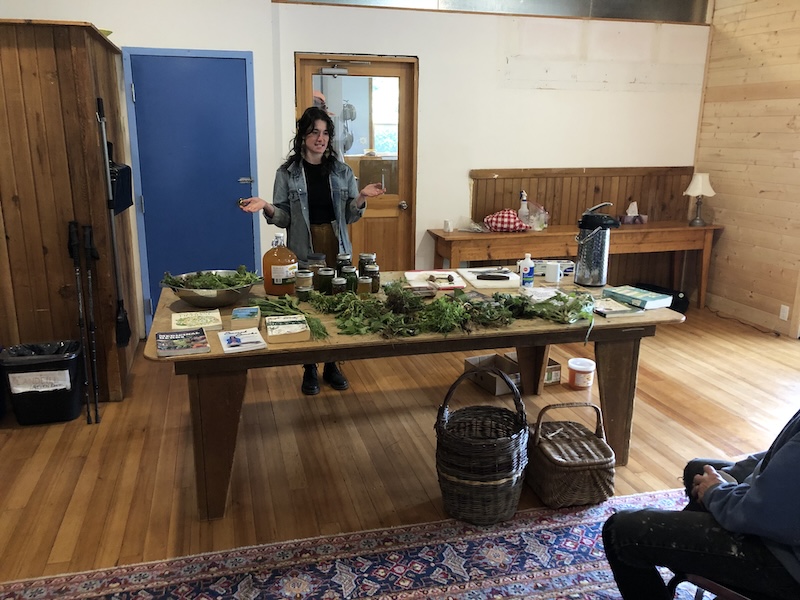
The last workshop, ‘Herbal Wisdom,’ was also in the Lakeview Room. Autumn Barrett-Morgan had a table filled with loose bunches of freshly harvested herbs, herbs in jars, a gallon of apple vinegar, a cutting board, cutting utensils and many well-read books. A large metal thermos filled with lemon balm tea beckoned for any who were thirsty. The large wicker baskets used to transport these things stood at the foot of the table, adding to the workshop’s folksy atmosphere.
People spread out in chairs and couches to listen. Most were rapt in attention, but someone seized the opportunity to nap at the back.
Autumn began, ” For those who don’t know me, my name is Autumn and I am a folk herbalist. Currently pursuing further training in animal herbalism. Herbs have always been a part of my life, but I started working deeply with herbs many years ago, and in recent years I completed Rosemary Gladstar’s Science and Art of Herbalism course.”
“ If anybody is interested in embarking on a herbal journey through a course, that course is a community herbalist program that is science-based, art-based, focuses on the understanding of the human body systems, plant body systems, animal body systems, how plants grow in their environment, and touches on the spiritual side of herbs.”
”It is a very enriching course, and I highly recommend it. I consider Rosemary Gladstar, my herbal teacher and one of her mentors, the late Juliette de Bairacli Levy, is very much a mentor of mine as well. I have been studying Rosemary and Juliette’s books for many years, and Juliette is my inspiration for embarking in animal herbalism as a field. Juliet passed away many years ago, but she is very special to me. So these two teachers will be present with us today as I share some of this knowledge.”
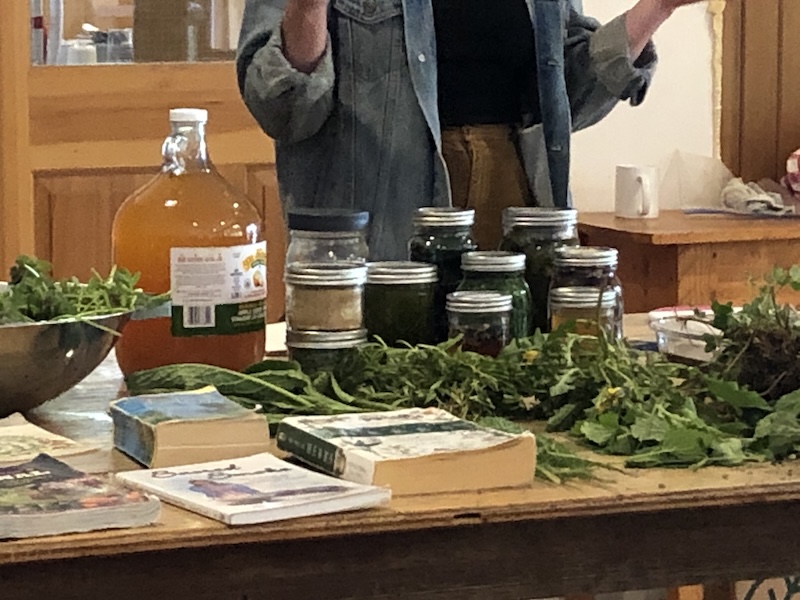
“ I brought a small sample of my book collection. I have far more at home. Marnie is my main source of books.”
Many heads turned to where Marnie Andrews was sitting. She is the owner of Marnie’s Books, Cortes Island’s only bookstore. Her face seemed to melt into a pleased glow at the acknowledgement.
Autumn continued, “Books are the gateways to ancestral herbal knowledge. Please do not rely on AI to retrieve herbal information. It is not a safe or reliable source, but rather gather plenty of books and dive in.”
“You can take courses and embark on that journey. I find that helpful, to have a curriculum. It’s sequential. It helps me organize my thoughts, but you can totally do this simply by diving into a good book from a herbalist author that you resonate with who has experience and start working with herbs.”
“You don’t need to have a course to incorporate herbs into your life, but if you want to go deeper with it, there are courses out there to support you in that. I will say though, that plants are powerful and it is important to spend time researching herbs before you start working with them on a consistent basis.”
One by one, she passed the loose herbs and jars of herbs around the room, explaining what they were, their properties, and how she uses them. Her talk was sprinkled with anecdotes and suggestions for further reading.
Autumn: ” Before you start working with a new herb, what I recommend to do is a plant sit. Sit with the plant for around 20 minutes or so, and you’ll be surprised by what you learn and what you receive. It’s such a great way to build relationships with these plants. I also recommend that you do an allergy test before consumption.”
“Rub a small amount of the plant onto a patch of your skin and leave it for 24 hours. If you observe any redness, itchiness, or reaction, that might not be your plant to work with. There are certain families of plants. For example, the Asteraceae family, which includes herbs that are generally considered safe like dandelion, chamomile, calendula and more. But some people and animals do have allergies to this family of plants, and ultimately every individual can react differently to any plant, whether it is a known allergen family or not. So trust your body and take the time to do that allergy test.”
”Before you start consuming plants, it is important to do that allergy test. If you do pass that allergy test and you’re becoming friends with these herbs, then you’ll want to know the proper dosage and length of time that is safe to consume these plants. Some herbs are not safe to consume over long periods, and therefore, I will say it is important to do your research first from the books written by trained herbalists, or to engage in a herbal consultation with a practitioner.”
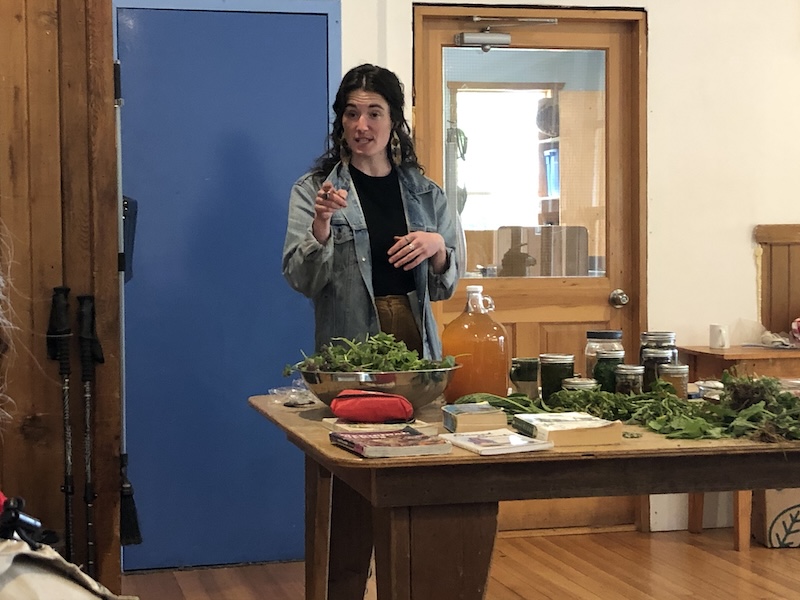
She explained that it is generally safe to eat those types of herbs that she had on display as food.
Autumn: “ Tinctures are stronger plant extracts, and therefore, if you’re working with tinctures, follow a proper dosage protocol, especially if you’re working with herbs with children and animals and or if you are pregnant nursing. Have a known medical condition or on any medication. It is very important for your safety to work with a healthcare practitioner prior to consuming herbs.”
“A naturopath or a healthcare practitioner who is well versed in herbs can support you in finding herbs that are safe for you to consume based on your specific needs and conditions.”
At the end of her presentation, Autumn gave a jar full of purple dead-nettle to everyone who wanted to experiment with it at home.
Links of Interest:
- The Next Generation of Linnaea Farm – Cortes Currents
- Articles about, or mentioning, Cortes Island’s seed bank
- The Science & Art of Herbalism – Rosemary Gladstar
Videos courtesy Linnaea farms Facebook page; Photos by Roy L Hales
Sign-up for Cortes Currents email-out:
To receive an emailed catalogue of articles on Cortes Currents, send a (blank) email to subscribe to your desired frequency:
Weekly Digest cortescurrents – [email protected]
Daily, (articles posted during the last 24 hours) – [email protected]