
A team of Australian and Japanese researchers have quantified the damage to human health that is done by eating red meat. If people shifted their diets from beef to such forage fish as anchovies, herring and sardines, the study found, an estimated 750,000 lives could be saved per year (The Guardian Weekly, April 19, 2024). The comprehensive study of 130 countries identified that human health deteriorates as red meat consumption rises.
The study also revealed the clear environmental benefits to shifting away from beef. Instead of feeding these nutritious forage fish to animals, which are how most of these aquatic species are consumed, the nutritional benefits that were passed directly to people would reduce the diseases caused by excessive beef consumption, but also save huge amounts of agricultural land that is presently used to raise cattle for beef.
About 2.5 billion hectares of land is used for raising livestock, which represents about 60% of all agricultural land, and about 20% of all land on Earth. In exchange, this land provides less than 2% of human calories and less than 5% of protein. Most of the bucolic fields that we see almost everywhere are growing hay to feed cows. Vast forests, which store carbon and moderate climate, are converted to fields to graze beef cattle and to grow the soya to feed the cattle industry.
This is not a trivial matter on a planet that is struggling to feed more than 8 billion people. Valuable food is used to grow beef cattle—the conversion factor just to grow just 1 kilogram of beef is 6 kilograms of corn, 6 kilograms of forage fish, or 20 kilograms of soya. About 80% of the ocean’s forage fish are fed to animals, although this marine bounty is perfectly safe for human consumption.
After oil, agriculture is the largest producer of greenhouse gases. The consensus among climatologists is that, after voting for politicians who are environmentally conscious and ending frivolous flying, the third most helpful thing anyone can do to arrest climate change is to stop eating red meat.
As ruminates, cattle belch and fart methane, a potent greenhouse gas. Their feces also pollute waterways, their browsing contributes to ecological destruction, and their hooves impair plant growth by compressing soils and facilitating erosion.
Eating beef is primarily a carryover from our ancestral history as hunters, and as a source of food it is not a particularly intelligent option for our modern world. High beef consumption is linked to cancer and heart disease. And we may be forced away from excessive beef consumption simply as a result of its expense compared to plant-based foods, its nutritional inefficiency and its environmental cost.
Red meat does have obvious nutritional value, and a total abandonment of it from our diets is not necessary, practical or even realistic. However, its presence as a major component in our meals could be drastically reduced and replaced with other foods. The evidence is that such a replacement would be not only healthier, but would be much more environmentally responsible.
Ray Grigg for Sierra Quadra
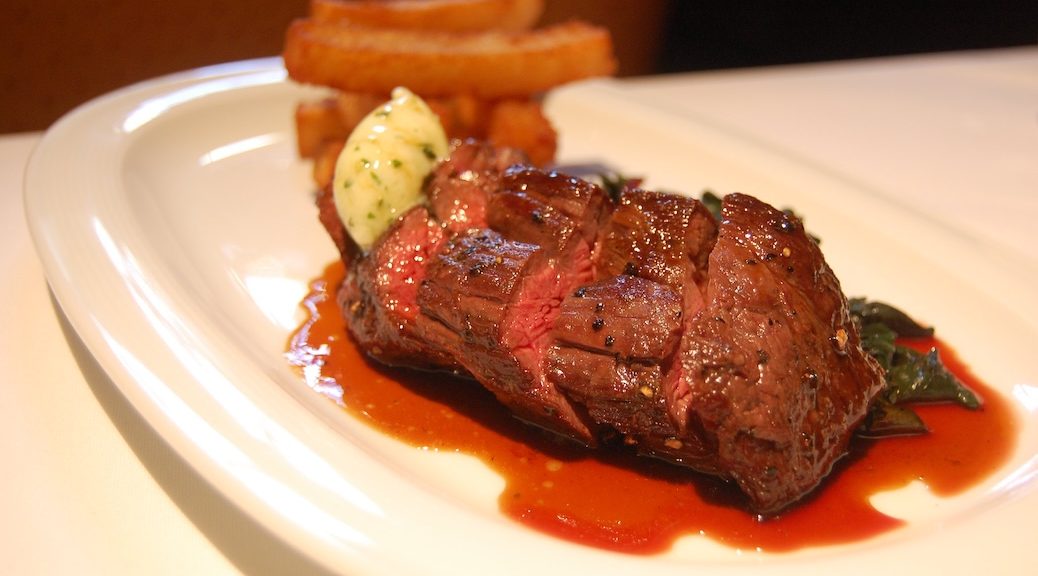
Top image credit: Steak dinner – Photo by Stu Spivak via Flickr (CC BY-SA 2.0)