
All posts by Guest Post

Earthquakes shake up areas north of Edmonton

By David Boles, St Albert Gazette, Local Journalism Initiative Reporter

Residents living just north of the Alberta capital may have felt the ground shake beneath them on more than one occasion in the last few weeks.

Several earthquakes have been felt in central and northern Alberta, including one in Sturgeon County on April 18 that Earthquakes Canada says registered at a magnitude of 4.1.

While relatively rare, earthquakes in Wild Rose Country are not uncommon.

“There are natural earthquakes, that are related to the movement of tectonic plates off the west coast were plates are sliding past one another and colliding,” said John Cassidy, an earthquake seismologist with Natural Resources Canada.

Another tremor to hit rural Alberta came on Saturday, when a 3.8 magnitude earthquake struck northeast of Fort Saskatchewan.

Earthquakes Canada says the first quake was industry-related, something Cassidy says is an example of an induced earthquake.

Continue reading Earthquakes shake up areas north of Edmonton

BC’s new data centre cluster sparks new discussion of ‘sovereign’ AI push

By Sonal Gupta, Canada’s National Observer, Local Journalism Initiative Reporter

TELUS is pushing ahead with plans for a major AI data-centre cluster in British Columbia after being selected under Ottawa’s large-scale AI data-centre initiative. But the project is raising questions about who will ultimately control that infrastructure and whether BC’s clean power grid can absorb the electricity demand.

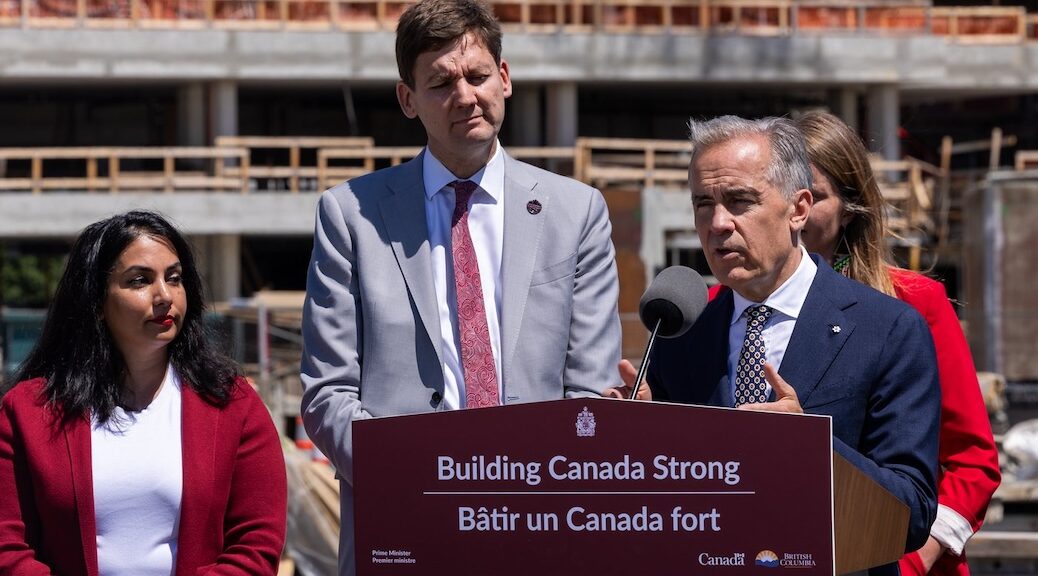
The project announced Monday with federal backing, would start with 85 megawatts of power from BC Hydro and scale to 150 megawatts, and over 60,000 NVIDIA GPUs, by 2032.

It includes three sites: an AI facility in Kamloops launching later this year, a Mount Pleasant location opening in 2026 and expanding through 2028 and a 10-storey data centre near BC Place set for 2029.

Continue reading BC’s new data centre cluster sparks new discussion of ‘sovereign’ AI push

Lost in Transmission

By Will Noel, Pembina Institute

Alberta has abundant wind and solar energy but these resources are being wasted at record levels and driving costs up for consumers in the process. 

At the heart of the issue is a set of technical and regulatory barriers that mean clean, affordable, electricity is being wasted when Albertans need it most. 

This report provides an overview of the crux of the issue: while there is abundant, affordable, and clean energy available in Alberta, there isn’t enough transmission capacity to bring that energy to homes and businesses across the province.  This issue is leading to:

Continue reading Lost in Transmission

Alberta’s oil and gas cleanup problem is growing

By Janetta McKenzie, Pembina Institute

Alberta taxpayers, municipalities, and rural landowners are facing increasing costs and harms from inactive and orphaned oil and gas wells, Calgarians heard at a town hall Tuesday evening.

Co-hosted by the Pembina Institute, Alberta Environmental Network, For Our Kids and the Polluter Pay Federation, the Clean Up Your Mess town hall included expert presentations and first-hand landowner experiences of the growing oil and gas cleanup problem.

On April 9th, 2026, more than 4,000 wells and hundreds of other pieces of infrastructure were transferred to the Orphan Well Association following the closure of Long Run Exploration. This is the largest transfer to the OWA in Alberta’s history, doubling the association’s inventory overnight. Despite a 100 per cent increase in orphan wells, the levy paid by industry is rising by only seven per cent this year.

Continue reading Alberta’s oil and gas cleanup problem is growing

Area B Director’s Report: Cortes Quarry expansion?

By Regional Director Mark Vonesch

As many of you are aware, 2385425 Alberta Ltd. (Island United) has applied to increase the size of the tenure of their quarry on Cortes Island from 1.25ha to 5.16ha.

Applications have been submitted to the Ministry of Forests and the Ministry of Mining and Critical Minerals to increase the footprint, approve washing as a permitted activity, introduce a concrete plant, and increase the annual extraction rate to a maximum of 39,999 tonnes per year (up from approximately 5,000 tonnes per year).

These applications impact public land and our community and there is now opportunity for us, the public, to provide input into the decision.

Continue reading Area B Director’s Report: Cortes Quarry expansion?