
Tag Archives: Cortes History

Gumboots in the Straits Comes To Gorge Hall

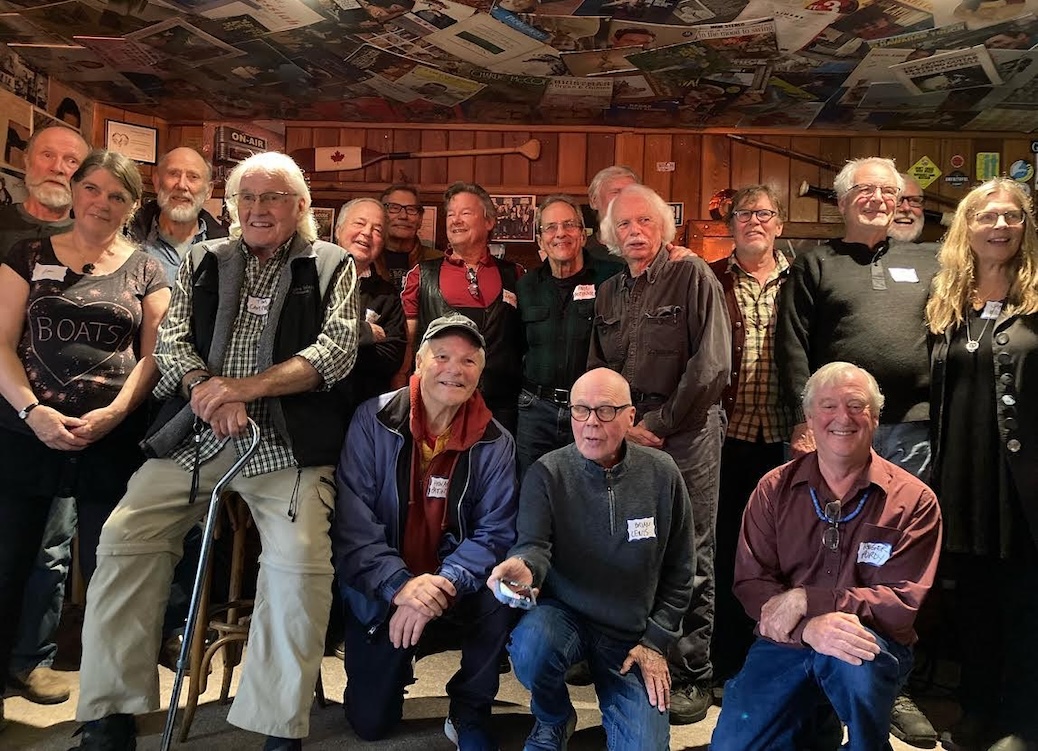
Book #4 of the Gumboot series, ‘Gumboots in the Straits’ is coming to Gorge Hall on Cortes Island on Saturday, September 20.

From 1:00 to 3:00 pm, six Cortes Island authors featured in this volume will give free public readings from their contributions.

Later in the day, from 5:00 to 7:00 pm, food and drinks will be available for purchase, followed by an evening of dancing to Cortes Island’s own He Said; She Said. Tickets for the dance are $25 and can be purchased at Marnie’s Bookstore and the Cortes Island Museum.

In this morning’s interview, we’ll be joined by Jane Wilde, the originator of the Gumboots series. She’ll also share short readings from some of the Cortes writers featured in Gumboots in the Straits.

Continue reading Gumboots in the Straits Comes To Gorge Hall

Kwakwaka’wakw artist Ernest Puglas explains how carving saved his life: ‘This is powerful’

As a new welcome pole is raised on Klahoose, Homalco and Tla’amin territories, its maker describes how, through art, ‘I have recreated myself’

Editor’s note: The author of this profile sits on the board of the Cortes Community Foundation, which commissioned Puglas’s welcome pole. IndigiNews is honoured to share Puglas’s story.

By  Forrest Berman-Hatch, IndigiNews,, Local Journalism Initiative Reporter

Standing before a crowd of roughly 50 people on “Cortes Island,” carver Kuma’inukw (Ernest) Puglas first acknowledges his Kwak’wala lineage.

Then, he thanks the Klahoose First Nation for hosting him and for the honour of carving on its territories (the island is the traditional lands of Klahoose, Homalco and Tla’amin Nations), before unveiling his newest cedar welcome pole in a public ceremony.

Continue reading Kwakwaka’wakw artist Ernest Puglas explains how carving saved his life: ‘This is powerful’

How did settlers get to British Columbia?

Europeans knew about North America for over a century before they began settling here. Basque, Portuguese, French, and English fishermen regularly sailed to Newfoundland and Nova Scotia in the 1500s and 1600s for the rich offshore cod harvest. They often camped on the beaches but rarely stayed through the harsh winters. At the time, most Europeans lived in smoky, windowless huts heated by an open fire on the floor—hardly an incentive to brave even colder conditions overseas.

Archaeologist William Gilbert, working at Cupids in Newfoundland, suggests a few changes in homes construction changed everything.

“Recently it has been suggested that the late 16th century innovations such as fireplaces, wooden floors, glazed windows and woolen and felt clothing may have made it easier for Europeans to adapt to and survive during our cold northeastern winters. The first successful colony was established at Port Royal in Nova Scotia in 1605, followed by Jamestown, Virginia, in 1607, Quebec City in 1608, and Cupids in 1610.”

Continue reading How did settlers get to British Columbia?

Schools of Squirrel Cove

Originally published January 22, 2024. This is the first audio recording of the article below, and may have sufficient additional details to be called the most recent version. The text was originally published in the booklet Squirrel Cove (Cortes Island Museum & Archives Society)

At the beginning of the 1900s, Squirrel Cove on the east side of Cortes Island was a hub of activity for homesteaders, loggers, fishermen, miners and trappers. They came from all the surrounding islands for supplies, groceries, mail, repairs, radios and dances in the hall. There were two stores, a post office, church, hall, two machine shops, a boatworks, a marine ways, and a big dock where the Union Steamships stopped regularly. Jim Spilsbury also stopped frequently to install or repair his radios in boats and homes.

Continue reading Schools of Squirrel Cove

At The Museum: ‘Won’t You Be My Neighbour’ Exhibit Explores Community Life In Cortes Island

What does it mean to be a neighbour on Cortes Island? This  question is at the heart of the new Cortes Island Museum exhibition ‘Won’t You Be My Neighbour?’ curated by Melanie Boyle, Managing Director of the museum and Monica Hoffman. Opening Sunday May 4th the exhibit invites visitors on a visual and narrative journey through both the historical and contemporary communities that shaped life on the island.

“The  idea of focusing on neighbourhoods came from the prior exhibition, ‘From the Ground Up,” explained Hoffman.

Boyle added, “We did touch on how people work together to build structures, in terms of collaboration.  It was also about repurposing material and sharing of resources and, in a way, this is also what this new exhibition is about. Collective land arrangements are a way for people to live affordably on Cortes, to share  the land, but also to share the material, resources and work collaboratively. So there’s a lot of overlap.” 

Continue reading At The Museum: ‘Won’t You Be My Neighbour’ Exhibit Explores Community Life In Cortes Island