

According to Jonathan Haidt, the fracturing rather than the integrating character of social media’s dynamic began to change in 2009 with the introduction of “Like” and “Sharing”, two similar options that transformed the exchange of person-to-person information into the mass distribution of opinions, rumours and judgments, without providing any substantial corroborating information. This process was abetted by the social media algorithms that favoured emotional rather than rational responses. Facts were boring. Extremism and lies generated more “sharing”, registered more “likes”, and earned more advertising revenue for the social media platforms.
Continue reading The Quadra Project: Social Media (P 2 of 4)Category Archives: Uncategorized

The Quadra Project – Social Media
“We invent things, and thereafter they invent us.” This is a fundamental principle in the media theory articulated by Marshall McLuhan, but it is rarely considered because we are usually so enamoured by the ingenuity of our inventions that we fail to consider the ways in which they invent us.
A brilliant essay by Jonathan Haidt, “Why the Past 10 Years of American Life Have Been Uniquely Stupid”, in the May 2022 edition of The Atlantic Monthly magazine deserves careful reading and thought. Its insights do much to explain the factious irrationality that has been generated by social media, an adjunct of the internet that was supposed to facilitate and deepen communication, but instead has created angry disputes with irresolvable differences. What went wrong?
Continue reading The Quadra Project – Social Media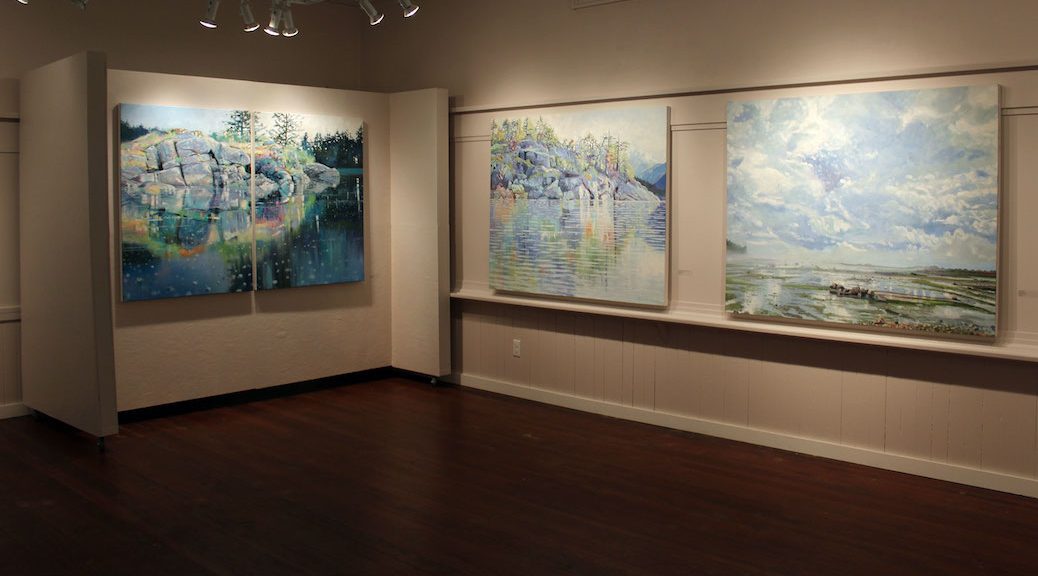
A Review of ‘Waterscapes’ at the Old Schoolhouse Gallery

Art is not simple. It is rife with contradictions and has a mandate to baffle. This seems especially true when the artist has the ability to make the familiar unfamiliar. Naomi Carins is such an artist. Waterscapes, a solo exhibition of large representational paintings of island shorelines, continuing this coming weekend at the Old Schoolhouse Gallery, forces the viewer to reconsider what is realism, and what is abstraction.
Continue reading A Review of ‘Waterscapes’ at the Old Schoolhouse Gallery
Fresh look at an iconic display: The Cortes Island Water Cycle

Wild Cortes came into being as a result of a series of interactions between Laurel Bohart and Lynne Jordan, former President of the Cortes Island Museum. They started in 2005, shortly after Bohart moved to Cortes Island.
“I met Lynn Jordan on on the ferry. She had this parrot, an African grey, and it was dead and frozen. She wanted to find a taxidermist, so I mounted her bird. That was the beginning of Wild Cortes, because we did ‘Ravens Relations,’ and put it up in the museum for a few years. People were absolutely enthralled. They wanted to know if we would have more animals, so we dreamed up the original Wild Cortes, the story of water,” she explained.
Continue reading Fresh look at an iconic display: The Cortes Island Water Cycle
The Quadra Project: Climate Karma
Karma, from the Sanskrit word “karman” is an amalgamation of “action, effect, and fate”. In the popular sense of the word, it has come to mean that actions have consequences, and that our individual human behaviour exists in a cause-effect relationship with a vague sense of a moral cosmos. Often described as the Principle of Karma, it means that personal acts motivated by “good” intentions are eventually rewarded in kind, and that “bad” acts are also rewarded in kind.
Although karma usually applies to the cause-effect relationship of our individual actions, it might also apply to our collective actions, a more expansive understanding that is worth considering, given the consequence of the unfolding havoc we are causing on our planet.
Continue reading The Quadra Project: Climate Karma